
Listen to this article
Who Was Priscilla in the Bible? Her Ministry, Marriage, and Role in the Early Church
Priscilla was a prominent Christian worker in the first-century church who ministered alongside her husband, Aquila. Acts and Paul’s letters portray the couple as skilled workers, traveling ministry partners, hosts of house churches, and trusted coworkers in the gospel. Priscilla is especially remembered for helping Aquila explain “the way of God more accurately” to Apollos, an eloquent teacher who knew only the baptism of John (Acts 18:24–26). Paul later called Priscilla—also named Prisca—and Aquila his “fellow workers in Christ Jesus” and said they had risked their lives for him (Romans 16:3–4). Scripture clearly presents Priscilla as an active participant in discipleship and early Christian mission, although it does not assign her a formal title such as elder, pastor, or apostle. Christian traditions therefore agree on her importance while differing over how her example relates to contemporary church offices and women’s ministry roles.
Key takeaways
- Priscilla, also called Prisca, was a first-century Christian minister and missionary who consistently served alongside her husband, Aquila.
- She and Aquila met Paul in Corinth, shared his tentmaking trade, and later traveled with him to Ephesus (Acts 18:1–3, 18–19).
- Priscilla and Aquila took Apollos aside and explained the way of God to him more accurately, demonstrating theological understanding and skill in discipleship (Acts 18:24–26).
- Their homes served as gathering places for churches in Ephesus and Rome, showing their commitment to hospitality and congregational life (Romans 16:3–5; 1 Corinthians 16:19).
- Paul called the couple his fellow workers and stated that they had risked their lives for him, though Scripture does not explain the circumstances (Romans 16:3–4).
- Christians interpret Priscilla’s relevance to modern ministry roles differently, so her documented actions should be distinguished from conclusions about formal church offices.
Priscilla’s name and biblical setting
Priscilla appears six times with her husband, Aquila: Acts 18:2, 18, 26; Romans 16:3; 1 Corinthians 16:19; and 2 Timothy 4:19. Luke uses the form “Priscilla,” while Paul uses “Prisca” in the Greek text. These are generally understood as forms of the same Roman name rather than evidence of two different people. Acts introduces the couple in Corinth after Aquila had recently come from Italy because Emperor Claudius had ordered Jews to leave Rome (Acts 18:1–2). The passage explicitly identifies Aquila as a Jew from Pontus but does not directly state Priscilla’s ethnicity, birthplace, age, conversion story, or family background. Claims about those details are therefore speculative. Priscilla is named before Aquila in four of the six New Testament references. This is an observable biblical fact, but Scripture does not explain the ordering. Some interpreters infer that she had greater social prominence, theological ability, or ministry visibility; others caution that name order alone cannot prove rank or authority.
Priscilla and Aquila’s marriage and work with Paul
Paul stayed and worked with Priscilla and Aquila in Corinth because they shared the same trade, commonly translated as tentmaking or leatherworking (Acts 18:1–3). Their shared labor illustrates how ordinary work could support relationships and missionary activity in the early church. After an extended period in Corinth, Paul sailed for Syria, and Priscilla and Aquila accompanied him as far as Ephesus (Acts 18:18–19). The text repeatedly presents them as a ministry partnership. They worked, traveled, taught, hosted believers, and endured danger together. The New Testament does not provide a detailed portrait of their private marriage or state that every Christian couple must follow their exact ministry pattern. It does, however, offer a compelling example of spouses using their home, vocation, knowledge, mobility, and relationships in service to Christ.
What Priscilla and Aquila taught Apollos
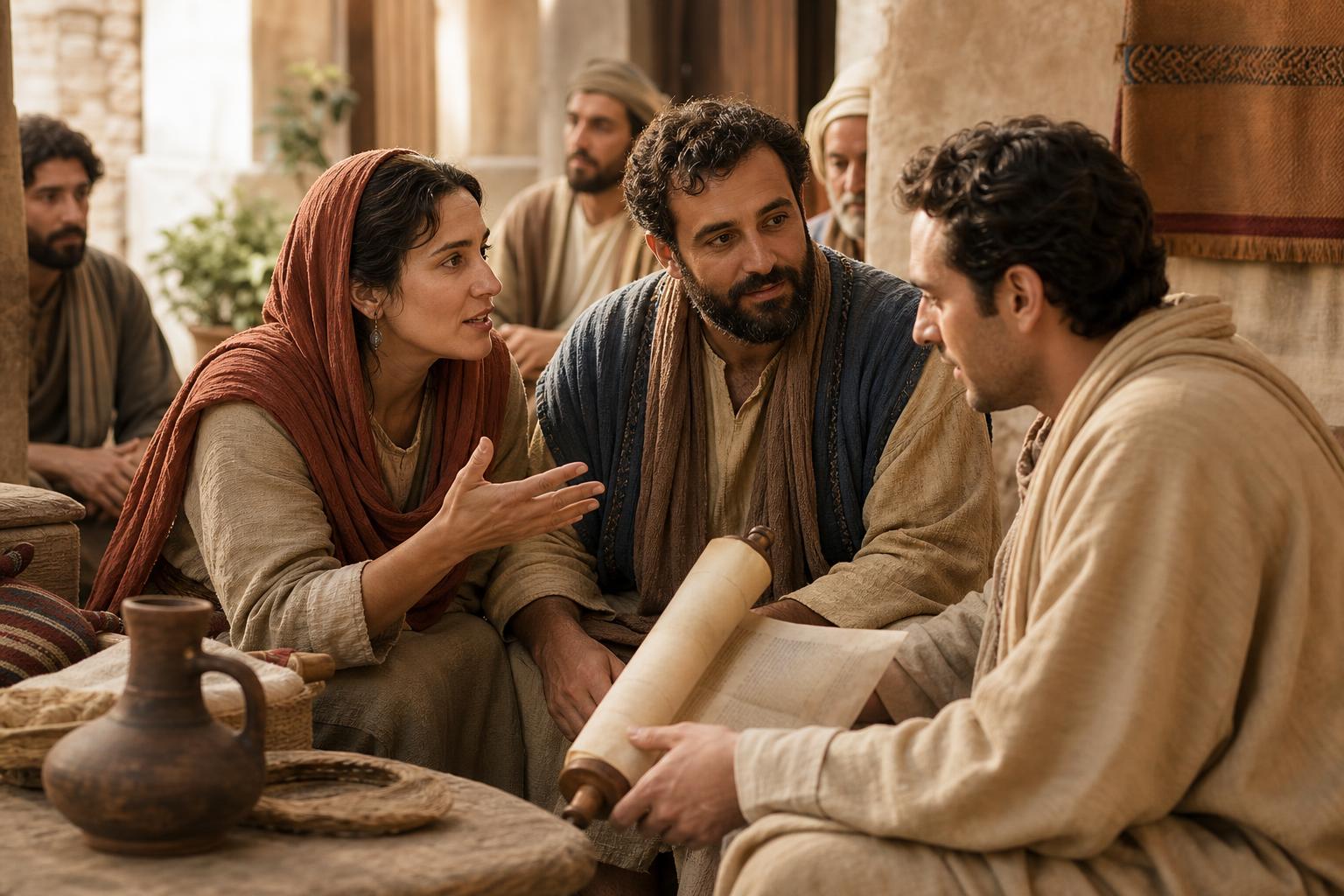
In Ephesus, Priscilla and Aquila heard Apollos speaking in the synagogue. Acts describes him as eloquent, competent in the Scriptures, fervent in spirit, and accurate in what he taught about Jesus, but says he knew only the baptism of John (Acts 18:24–25). The couple “took him aside and explained to him the way of God more accurately” (Acts 18:26). The passage does not record their exact words, but the context indicates that they helped complete or clarify his understanding. Apollos subsequently traveled to Achaia, where he greatly helped believers and publicly demonstrated from the Scriptures that Jesus was the Christ (Acts 18:27–28). This episode shows that Priscilla participated with Aquila in the theological formation of a gifted male teacher. It also models correction that is relational rather than humiliating: they recognized Apollos’s strengths, addressed what was incomplete, and prepared him for more effective service.
Priscilla’s role in house churches and early Christian mission
Priscilla and Aquila opened their home to Christian communities in more than one city. Paul sent greetings from “Aquila and Prisca, together with the church in their house” while writing from Ephesus (1 Corinthians 16:19). Later, when addressing believers in Rome, he greeted the couple and “the church in their house” (Romans 16:3–5). House churches were important centers of worship, fellowship, teaching, prayer, and shared meals in early Christianity. Hosting one likely required hospitality, resources, courage, and sustained service. The texts do not define Priscilla’s precise responsibilities in these gatherings, so it would go beyond Scripture to assign her a specific formal office solely from these references. Nevertheless, the repeated connection between the couple and congregations meeting in their home supports the conclusion that they were deeply involved in church formation and community life.
Why Paul called Priscilla a fellow worker
In Romans 16:3–4, Paul called Prisca and Aquila his “fellow workers in Christ Jesus.” He added that they had risked their necks—an expression meaning they had endangered their lives—for him. Paul said that he and all the churches of the Gentiles gave thanks for them. This is one of the clearest statements about their standing in Paul’s ministry network. They were not merely casual acquaintances or passive hosts; Paul regarded them as trusted collaborators whose courageous service benefited multiple congregations. Scripture does not identify the event in which they risked their lives, so proposed connections to unrest in Corinth, Ephesus, or another crisis remain inferences. Paul’s final greeting to Prisca and Aquila in 2 Timothy 4:19 also suggests an enduring relationship. Depending on how one dates and understands 2 Timothy, the greeting may place them back in or near Ephesus, but the verse itself only names them among those to be greeted.
Was Priscilla a pastor, teacher, or church leader?
The biblical evidence supports several careful conclusions. Priscilla was Paul’s fellow worker, participated in instructing Apollos, traveled in connection with missionary work, helped host churches, and shared in costly service for the gospel. The New Testament does not explicitly call her a pastor, elder, bishop, deacon, or apostle. Christian traditions interpret the implications differently. Egalitarian readers often view Priscilla’s instruction of Apollos and her prominence in Paul’s network as evidence that women may teach and lead men in the church. Complementarian readers affirm her substantial ministry while distinguishing this act of instruction—performed with her husband after taking Apollos aside—from the governing or authoritative teaching office they understand other passages to reserve for qualified men. Other traditions establish ministry roles through different combinations of Scripture, historical practice, ordination theology, and church authority. A responsible Priscilla and Aquila Bible study should not erase these differences or claim that Acts 18 alone resolves every debate. It should begin with what the text plainly says: Priscilla was a knowledgeable, courageous, hospitable, and respected coworker in the gospel whose ministry strengthened teachers, missionaries, and congregations.
Lessons from Priscilla’s life and ministry
Priscilla’s example offers practical guidance without requiring readers to speculate about details Scripture does not reveal: – **Use work and home for Christian service.** The couple’s trade supported relationships, while their home became a gathering place for believers. – **Practice humble, accurate discipleship.** They did not publicly embarrass Apollos; they came alongside him and helped him understand more fully. – **Serve through partnership.** Priscilla and Aquila repeatedly appear together, showing the value of shared mission in marriage and Christian community. – **Recognize and develop other people’s gifts.** Their correction did not suppress Apollos’s ministry but equipped him to become more effective. – **Remain faithful across changing circumstances.** The couple served in Corinth, Ephesus, and Rome, adapting their ministry to new locations. – **Hold conviction with interpretive humility.** Priscilla’s ministry is clear, but conclusions about formal offices should be made in conversation with the whole counsel of Scripture and the beliefs of one’s church tradition.
FAQs
What are the main facts about Priscilla in the Bible?
Priscilla, also called Prisca, was married to Aquila, shared his trade, worked with Paul, traveled from Corinth to Ephesus, helped instruct Apollos, hosted churches in her home, and risked her life in connection with Paul’s ministry. These facts appear in Acts 18:1–3, 18–26; Romans 16:3–5; 1 Corinthians 16:19; and 2 Timothy 4:19.
Why is Priscilla sometimes named before Aquila?
Priscilla appears first in four of the couple’s six New Testament references, but Scripture does not explain why. The order may indicate prominence, social status, ministry visibility, or normal variation in naming. It should not be treated as conclusive proof of her rank or formal church office.
What does Priscilla’s story teach about women in the early church?
Her story demonstrates that women made substantial contributions to early Christian discipleship, mission, hospitality, theological instruction, and congregational life. Christians differ on whether her example supports women serving in every ordained or governing office. The passage should therefore be honored for what it explicitly records while questions about contemporary offices are considered alongside other biblical texts and each church tradition’s theology.
Go deeper in study
Use FaithPath resources for Bible study, reflection, and small-group discussion.

Leave a Reply