
Listen to this article
Who Was Deborah in the Bible? Her Story, Leadership, and Legacy
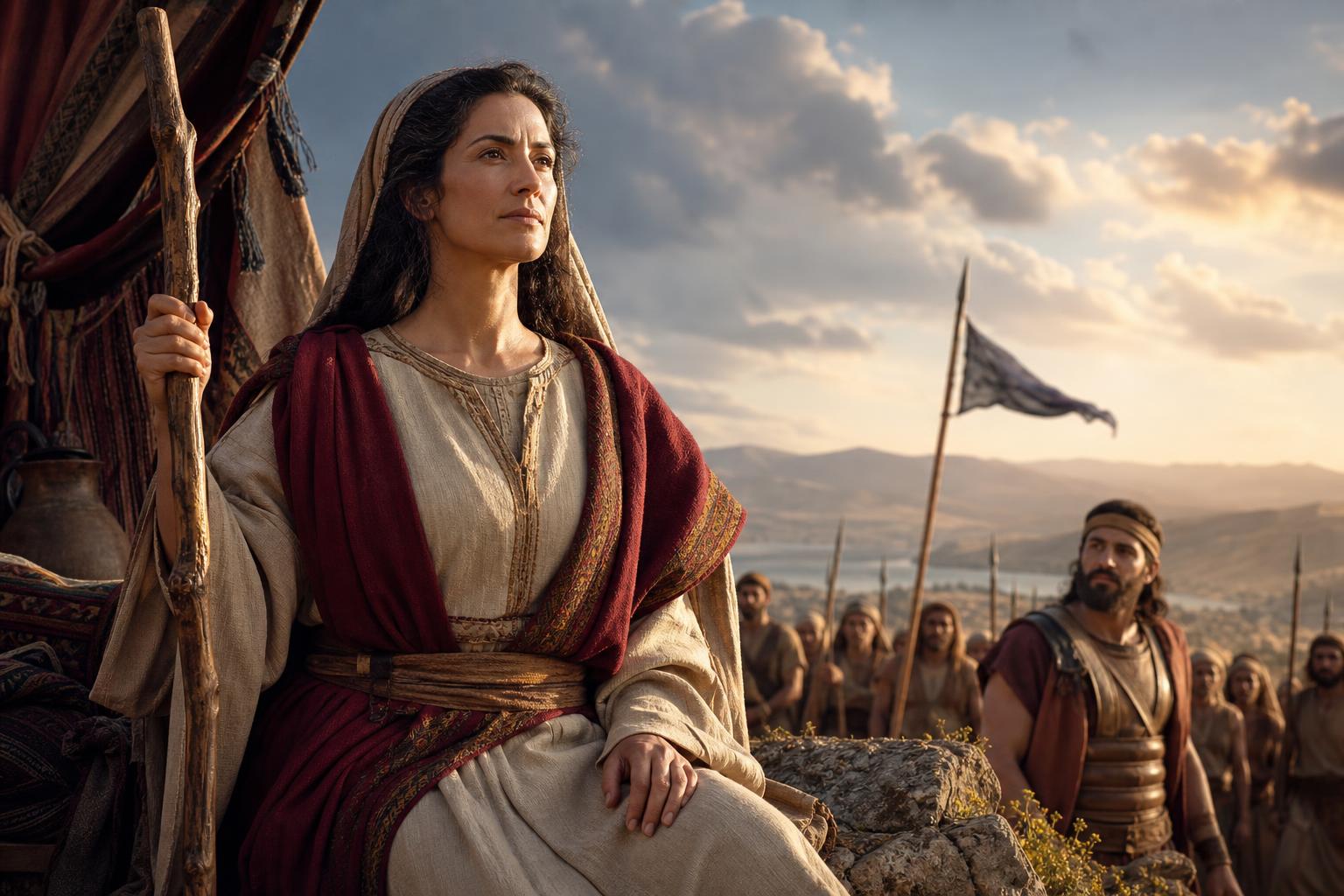
Deborah was a prophet, judge, and respected leader in Israel during the turbulent period before the monarchy. Her story in Judges 4–5 describes how God used her to summon Barak, encourage Israel’s forces, and announce deliverance from the oppression of King Jabin and his commander Sisera. Deborah accompanied Barak during the campaign, while Jael ultimately killed Sisera. Judges 4 presents the events as a prose narrative, and Judges 5—the Song of Deborah—celebrates the victory through poetry, worship, and theological reflection. Together, these chapters portray Deborah as a wise, courageous servant whose leadership directed Israel’s attention to the Lord.
Key takeaways
- Deborah is explicitly identified as a prophetess and is shown exercising judgment for Israel in Judges 4:4–5.
- She communicated God’s command to Barak and accompanied him as Israel confronted Sisera’s powerful forces.
- Israel’s victory belonged to the Lord, even though God worked through Deborah, Barak, willing Israelite volunteers, and Jael.
- Judges 4 gives a prose account of the deliverance, while Judges 5 interprets and celebrates it through the Song of Deborah.
- Deborah’s example offers enduring lessons about courage, discernment, shared leadership, worship, and obedience.
- Christian traditions apply Deborah’s story differently to contemporary church leadership, so conclusions should be presented with humility and attention to broader biblical interpretation.
Deborah’s historical setting in the Book of Judges
Deborah lived during the period of the judges, after Israel entered Canaan and before the establishment of the monarchy. Judges repeatedly describes a cycle in which Israel turns away from the Lord, experiences oppression, cries out for help, and receives deliverance through leaders raised up by God. According to Judges 4:1–3, Israel came under the oppression of Jabin, a Canaanite king associated with Hazor. His military commander, Sisera, possessed 900 iron chariots and oppressed Israel for 20 years. Chariots gave Canaanite forces a formidable advantage on suitable terrain, making Israel’s situation appear militarily hopeless. This background is essential to the Deborah Bible story. Her leadership emerged during a national crisis marked by fear, disunity, and foreign domination. Judges 5:6–8 poetically remembers unsafe roads, abandoned village life, and the need for someone to arise on Israel’s behalf.
Deborah as prophet, judge, and “mother in Israel”
Judges 4:4 introduces Deborah as “a prophetess” and the wife of Lappidoth. As a prophet, she communicated God’s message rather than merely offering personal strategy. Her authority in the narrative is closely connected to hearing and faithfully declaring the word of the Lord. Deborah also held court under the palm of Deborah between Ramah and Bethel in the hill country of Ephraim. The Israelites came to her for judgment (Judges 4:5). This depicts her as a recognized source of wisdom and justice. Although the Book of Judges uses the term “judge” for leaders with varied functions, Deborah clearly participated in resolving disputes and guiding the people. In the victory song, Deborah describes herself as “a mother in Israel” (Judges 5:7). The expression communicates protective, restorative, and covenant-oriented leadership. It should not be reduced to biological motherhood. In context, Deborah had arisen to serve a vulnerable people and help restore Israel’s communal life.
Deborah and Barak explained
Deborah summoned Barak from Kedesh in Naphtali and delivered the Lord’s command: he was to gather 10,000 men from Naphtali and Zebulun and lead them to Mount Tabor. God promised to draw Sisera and his forces toward the Kishon River and give them into Barak’s hand (Judges 4:6–7). Barak replied that he would go if Deborah went with him. Readers interpret his response in different ways. Some see hesitation or deficient faith, while others emphasize his recognition that Deborah represented God’s prophetic presence and direction. Hebrews 11:32 later includes Barak among examples associated with faith. The text therefore warrants a nuanced assessment rather than a simplistic dismissal of him. Deborah agreed to accompany Barak but announced that the honor of the expedition would not ultimately belong to him, because the Lord would deliver Sisera into the hand of a woman (Judges 4:9). This prediction is fulfilled through Jael, not Deborah. Deborah and Barak then traveled together, and Barak assembled the forces as commanded. Judges 4:14 records Deborah’s decisive encouragement: “Up! For this is the day in which the Lord has given Sisera into your hand.” Barak led the troops into battle, but the narrative emphasizes that the Lord routed Sisera and his army. Deborah’s role was neither passive nor identical to Barak’s. She delivered God’s command, strengthened the appointed military leader, accompanied the campaign, and interpreted the moment through faith.
Jael, Sisera, and Israel’s deliverance
After Sisera’s army was defeated, he abandoned his chariot and fled on foot to the tent of Jael, the wife of Heber the Kenite. Jael welcomed him, concealed him, and gave him milk. When Sisera fell asleep, she killed him with a tent peg and hammer (Judges 4:17–22). Jael’s action fulfilled Deborah’s prophecy that Sisera would be delivered into the hand of a woman. The account is violent and reflects the realities of warfare in the ancient world. Readers should neither erase that violence nor imitate it as a general model for Christian behavior. Within Judges, the event signifies the downfall of an oppressor and the fulfillment of God’s announced judgment. Barak arrived while pursuing Sisera, and Jael showed him the dead commander. Israel continued pressing against Jabin until his power was destroyed (Judges 4:23–24). The victory came through several participants, but Judges consistently attributes the decisive deliverance to the Lord.
How Judges 4 and the Song of Deborah complement each other
Judges 4 and 5 recount the same deliverance in different literary forms. Judges 4 is a prose narrative that follows the main sequence of events: Deborah’s summons, Barak’s mobilization, Sisera’s defeat, and Jael’s killing of Sisera. It helps readers understand who acted, where the conflict occurred, and how Deborah’s prophecy was fulfilled. Judges 5 is poetic. Often called the Song of Deborah, it is sung by Deborah and Barak after the victory. Rather than simply repeating the narrative, the song interprets the event as an act of God. It celebrates willing leaders and volunteers, describes cosmic and natural imagery in the battle, and says that the torrent Kishon swept the enemy away (Judges 5:20–21). The song also highlights Israel’s tribal responses. Zebulun and Naphtali are praised for risking their lives, while some groups are questioned or criticized for remaining uninvolved (Judges 5:14–18). Jael receives prominent praise, and Sisera’s mother is portrayed waiting in vain for his return. These poetic details deepen the emotional, communal, and theological meaning of the victory. Read together, the chapters provide a fuller account. The prose establishes the storyline; the poetry turns the deliverance into communal memory and worship. Judges 5:31 concludes with a prayer that God’s enemies would perish and that those who love him would be like the rising sun. The land then had rest for 40 years.
Lessons from Deborah’s faith and leadership
**Faithful leadership begins with listening to God.** Deborah’s influence rested on her role as a prophet who faithfully communicated God’s command. Christian leadership should remain accountable to Scripture rather than relying only on personality, status, or confidence. **Courage can be expressed by strengthening others.** Deborah did not seek every role for herself. She summoned Barak, communicated his calling, accompanied him, and encouraged him at the decisive moment. Her story presents leadership as both courageous and collaborative. **God’s work can involve many participants.** Deborah, Barak, Israel’s volunteers, and Jael each played different roles. The song praises those who willingly offered themselves while giving ultimate glory to the Lord. Healthy ministry likewise recognizes varied gifts without confusing human service with divine power. **Worship helps communities remember rightly.** Judges 5 transformed the victory into testimony. It named God as the deliverer, honored faithful participation, confronted passivity, and taught a later generation how to interpret the event. **Leadership should serve the well-being of God’s people.** Deborah’s description as a “mother in Israel” points toward leadership that protects, restores, and seeks justice. Her authority was exercised for the community during a time of oppression.
Deborah and contemporary discussions about women in church leadership
Deborah is an important biblical example of a woman exercising recognized spiritual and public leadership. Christians across traditions affirm her faithfulness, prophetic role, wisdom, and contribution to Israel’s deliverance. They do not all agree, however, about how her Old Testament role should be applied to offices in the contemporary church. Some Christian traditions understand Deborah as part of a broader biblical pattern supporting women serving in pastoral, teaching, and governing roles. Other traditions affirm Deborah’s God-given leadership in Israel while distinguishing the office of judge or prophet from New Testament qualifications for pastors or elders. Still others occupy positions between these approaches. Judges 4–5 should be allowed to say clearly what it says: Deborah was a genuine prophet, a recognized source of judgment, and a central leader in Israel’s deliverance. At the same time, responsible discussions about present-day church offices should consider the full range of relevant biblical texts and acknowledge denominational differences without portraying one contested conclusion as universally accepted.
FAQs
Was Deborah the only female judge in the Bible?
Deborah is the only woman explicitly presented as judging Israel in the Book of Judges. Judges 4:4–5 identifies her as a prophetess and says the Israelites came to her for judgment. Her combination of prophetic, judicial, and national leadership is distinctive in the biblical record.
Did Deborah lead Israel’s army into battle?
Barak served as the military leader and led the troops into battle, while Deborah delivered God’s command, accompanied Barak, and announced when the time had come to advance. It is therefore more precise to describe Deborah as the prophetic and national leader who commissioned and encouraged Barak rather than as the battlefield commander.
What is the main message of Deborah’s story?
Deborah’s story emphasizes that the Lord delivers his people and can work through faithful participants with different roles. It also highlights courageous obedience, wise leadership, cooperation, willingness to serve, and the importance of remembering God’s acts through worship. Applications to modern church offices vary among Christian traditions.
Go deeper in study
Use FaithPath resources for Bible study, reflection, and small-group discussion.

Leave a Reply