
Listen to this article
The Story of Joseph: Forgiveness, Providence, and Family Restoration
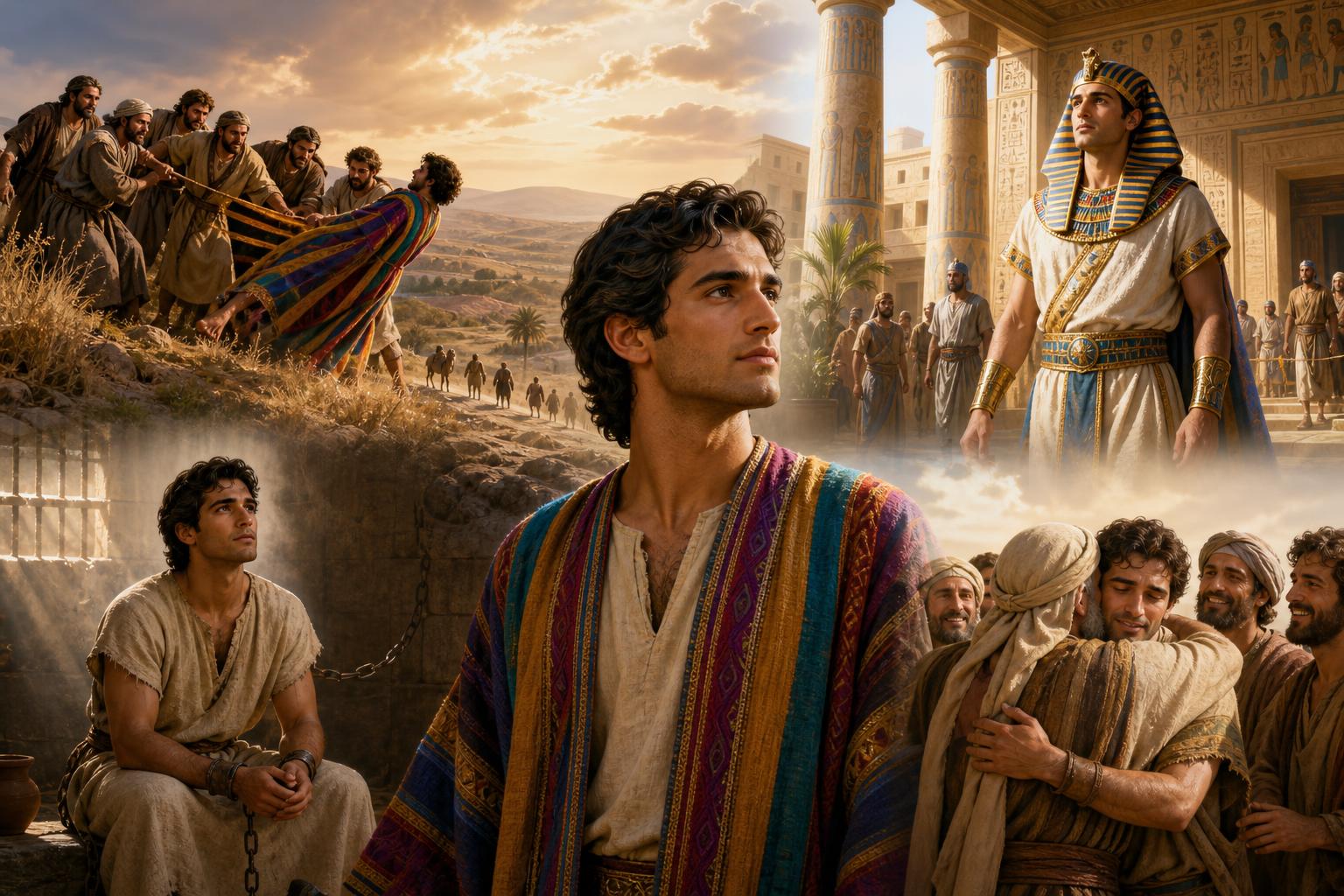
The story of Joseph in the Bible, explained across Genesis 37–50, follows Jacob’s favored son from betrayal and slavery to leadership in Egypt and reconciliation with his family. Joseph is sold by his brothers, falsely accused, imprisoned, and eventually appointed to prepare Egypt for famine. Through these painful events, God preserves many lives and begins restoring a divided family. Joseph’s declaration that his brothers intended evil but God intended good does not make the evil insignificant; it shows that human wrongdoing cannot prevent God from accomplishing his preserving purposes (Genesis 50:20).
Key takeaways
- Joseph’s story unfolds primarily in Genesis 37–50 and connects the family narratives of Genesis with Israel’s later life in Egypt.
- Joseph experiences betrayal, enslavement, false accusation, imprisonment, responsibility, and eventual restoration.
- God’s providence does not mean that suffering is trivial, deserved, or always immediately understandable.
- Joseph forgives his brothers without pretending that their actions were harmless; he explicitly identifies what they did as evil.
- Family restoration develops through truth, repentance, changed behavior, mercy, and practical care.
- Joseph consistently uses his abilities to serve others, whether he is working in a household, enduring prison, or governing Egypt.
Joseph’s Family Tree and the Roots of the Conflict
Joseph belonged to the family through whom God had promised blessing to the nations. Abraham and Sarah were the parents of Isaac. Isaac and Rebekah were the parents of Jacob, later named Israel, and Esau. Jacob’s sons became the ancestors of the tribes of Israel. **Simplified family tree:** – **Abraham and Sarah** – **Isaac and Rebekah** – **Jacob, also called Israel** – With **Leah**: Reuben, Simeon, Levi, Judah, Issachar, and Zebulun – With **Rachel**: Joseph and Benjamin – With **Bilhah**: Dan and Naphtali – With **Zilpah**: Gad and Asher – Jacob also had a daughter named Dinah Jacob loved Joseph, Rachel’s son, more than his other sons and gave him a special robe (Genesis 37:3). This favoritism intensified an already troubled family situation. Joseph also reported negatively about some of his brothers and described dreams in which his family bowed before him (Genesis 37:2, 5–11). The dreams pointed toward future authority, but Joseph’s brothers interpreted them through their resentment. Favoritism, jealousy, poor communication, and unresolved family wounds prepared the setting for betrayal.
Joseph’s Story in Chronological Order
**1. Joseph’s dreams and his brothers’ hatred — Genesis 37:1–11** At age 17, Joseph tended his father’s flocks. He dreamed that his brothers’ sheaves bowed to his sheaf and that the sun, moon, and eleven stars bowed to him. His brothers hated him, while Jacob kept the matter in mind. **2. Joseph is sold into slavery — Genesis 37:12–36** Jacob sent Joseph to check on his brothers. When they saw him approaching, they plotted to kill him. Reuben persuaded them not to shed his blood, intending to rescue him later. While Reuben was absent, the brothers followed Judah’s proposal and sold Joseph to traveling merchants. They dipped Joseph’s robe in goat’s blood and allowed Jacob to conclude that a wild animal had killed him. **3. Joseph serves in Potiphar’s house — Genesis 39:1–6** Joseph was taken to Egypt and sold to Potiphar, an officer of Pharaoh. Genesis repeatedly states that the Lord was with Joseph. Potiphar recognized Joseph’s effectiveness and placed him over his household. **4. Joseph is falsely accused and imprisoned — Genesis 39:7–23** When Potiphar’s wife pressured Joseph to sleep with her, he refused, describing the act as both a betrayal of trust and a sin against God. She then falsely accused him, and Potiphar sent him to prison. Even there, the Lord was with Joseph, and the prison keeper entrusted responsibilities to him. **5. Joseph interprets dreams in prison — Genesis 40** Joseph interpreted the dreams of Pharaoh’s cupbearer and baker, acknowledging that interpretations belong to God. His interpretations came true: the cupbearer was restored, and the baker was executed. Although Joseph asked the cupbearer to remember him, the cupbearer forgot him for two full years. **6. Joseph interprets Pharaoh’s dreams — Genesis 41** Pharaoh dreamed of seven healthy cows consumed by seven thin cows and seven full heads of grain swallowed by seven thin heads. Joseph explained that Egypt would experience seven years of abundance followed by seven years of severe famine. He gave God credit for the interpretation and recommended storing grain. Pharaoh appointed the 30-year-old Joseph to oversee the plan. **7. Joseph’s brothers travel to Egypt — Genesis 42–44** When famine reached Canaan, Jacob sent ten sons to buy grain in Egypt. They bowed before Joseph without recognizing him, fulfilling the earlier dreams. Joseph concealed his identity and tested them, requiring them to bring Benjamin to Egypt. When Joseph arranged for Benjamin to appear guilty of theft, Judah offered himself in Benjamin’s place. This self-sacrificing response showed a striking change from the brothers’ earlier willingness to sacrifice Joseph. **8. Joseph reveals his identity — Genesis 45** Unable to contain his emotions, Joseph wept and told his brothers who he was. They were terrified, but Joseph invited them to come near. He recognized that God had worked through the events to preserve life, while still acknowledging that his brothers had sold him. Joseph then arranged for Jacob’s household to move to Egypt. **9. Jacob’s family settles in Egypt — Genesis 46–49** God reassured Jacob before the journey to Egypt (Genesis 46:1–4). Jacob reunited with Joseph and settled with his family in the region of Goshen. Before his death, Jacob blessed Joseph’s sons, Ephraim and Manasseh, and spoke blessings over his own sons. **10. Joseph reassures his brothers and dies in faith — Genesis 50** After Jacob died, Joseph’s brothers feared that he would seek revenge. Joseph wept when he heard their request. He answered, “You intended to harm me, but God intended it for good,” and promised to provide for them and their children (Genesis 50:20–21). Joseph died at age 110, trusting that God would eventually bring Israel out of Egypt and asking that his bones be carried to the promised land.
Joseph Bible Story Timeline
| Event | Joseph’s approximate age | Scripture | |—|—:|—| | Joseph receives dreams and is sold by his brothers | 17 | Genesis 37:2–28 | | Joseph serves in Potiphar’s household | Late teens or twenties | Genesis 39:1–6 | | Joseph is falsely accused and imprisoned | Twenties | Genesis 39:7–23 | | Joseph interprets the prisoners’ dreams | Twenties | Genesis 40 | | The cupbearer forgets Joseph for two additional years | Twenties | Genesis 40:23–41:1 | | Joseph interprets Pharaoh’s dreams and becomes governor | 30 | Genesis 41:25–46 | | Seven years of abundance pass | 30–37 | Genesis 41:47–49, 53 | | Joseph reveals himself during the second year of famine | About 39 | Genesis 45:6 | | Jacob arrives in Egypt at age 130 | About 39 | Genesis 47:9 | | Joseph reassures his brothers after Jacob’s death | Later adulthood | Genesis 50:15–21 | | Joseph dies in Egypt | 110 | Genesis 50:22–26 | Genesis gives exact ages for several major events but not for every stage. Ages marked as approximate should therefore be treated as a guide rather than a complete chronology.
God’s Providence in Joseph’s Story
God’s providence refers to God’s wise and sustaining involvement in creation and history. Joseph recognizes providence when he tells his brothers that God sent him ahead to preserve life (Genesis 45:5–8) and that God intended for good what they intended for evil (Genesis 50:20). This does not mean Joseph’s suffering was unimportant. Genesis calls attention to betrayal, grief, false accusation, confinement, fear, and years of separation. Joseph names his brothers’ intention as harmful rather than redefining it as good. The story distinguishes between sinful human motives and God’s ability to bring preservation through circumstances shaped by those motives. Readers should also avoid using Joseph’s story to promise that every hardship will soon lead to visible success. Joseph did not know the full outcome while he was in the pit, enslaved, or forgotten in prison. Some suffering remains difficult to understand, and Scripture includes faithful lament alongside trust. The lesson is not that believers can always identify a specific purpose behind each painful event. It is that suffering does not place a person beyond God’s presence, care, or ultimate redemptive purposes. Christian traditions may express the relationship between divine sovereignty and human freedom differently. Joseph’s story clearly holds together two truths: his brothers were responsible for real evil, and God was able to work through the larger course of events to preserve life.
Joseph Forgives His Brothers
Joseph’s forgiveness appears most clearly in Genesis 45 and 50. He does not deny what happened, immediately trust without discernment, or describe betrayal as harmless. Before revealing himself, he observes how his brothers respond to pressure, Benjamin’s vulnerability, and their father’s grief. Judah’s offer to take Benjamin’s place provides evidence that the family’s moral posture has changed (Genesis 44:18–34). When Joseph reveals himself, he weeps, speaks truth, offers reassurance, and provides a place for the family during the famine. Years later, he again refuses revenge and promises to care for his brothers’ children (Genesis 50:19–21). His forgiveness is therefore expressed through mercy and concrete provision. Forgiveness and reconciliation are related but not identical. Forgiveness rejects personal vengeance and entrusts justice to God. Reconciliation involves restored relationship and normally requires truth, safety, repentance, and rebuilt trust. Joseph’s story should not be used to pressure someone to return to an unsafe or abusive situation. Seeking pastoral care, professional counseling, legal help, or protective boundaries can be consistent with wisdom and Christian faith.
Lessons from Joseph in Genesis
**Faithfulness matters in hidden seasons.** Joseph acts responsibly in Potiphar’s house and prison long before receiving public authority (Genesis 39:2–6, 21–23). **Integrity may be costly.** Joseph refuses sexual sin and is falsely punished (Genesis 39:7–20). Doing what is right does not guarantee an easy or immediately rewarding outcome. **Abilities can be used in service to others.** Joseph’s administrative wisdom helps Egypt prepare for famine. He combines spiritual dependence with practical planning (Genesis 41:15–40). **Waiting can be painful.** Joseph is forgotten by the cupbearer for two years (Genesis 40:23–41:1). The narrative does not minimize the strain of delayed deliverance. **Repentance becomes visible through changed conduct.** Judah once helped sell Joseph but later offered himself to protect Benjamin. His actions demonstrate meaningful change (Genesis 37:26–27; 44:33–34). **Forgiveness tells the truth about evil.** Joseph calls his brothers’ plan harmful while choosing not to retaliate (Genesis 50:19–21). **God can preserve life through unexpected means.** Joseph’s position in Egypt becomes a means of feeding both Egyptians and his own family during famine. **Success does not erase grief.** Joseph’s repeated weeping shows that authority and achievement do not remove the emotional effects of loss and family separation.
Age-Appropriate Application Ideas
**For younger children:** – Create a picture timeline showing the robe, pit, prison, palace, grain, and family reunion. – Discuss how jealousy can hurt people and practice naming one kind way to respond when someone receives special attention. – Emphasize that God was with Joseph when his circumstances were difficult, not only when he became a leader. – Avoid graphic detail when describing violence, execution, or the false accusation. **For older children and teenagers:** – Compare Joseph’s response to temptation in Genesis 39 with situations involving peer pressure or private choices. – Discuss the difference between forgiveness, trust, and safe boundaries. – Invite students to identify ways Judah changed between Genesis 37 and Genesis 44. – Encourage a private journal entry or prayer about waiting, disappointment, or family conflict. **For adults and small groups:** – Map the major reversals in Joseph’s life and identify where the text says the Lord was with him. – Discuss how favoritism contributed to dysfunction in Jacob’s household. – Consider how churches can support people experiencing betrayal without offering simplistic explanations for suffering. – Choose one practical act of mercy that does not ignore truth, accountability, or safety. **For families:** – Read the story over several sessions rather than compressing Genesis 37–50 into one lesson. – Use colored cards to sort events into categories such as suffering, faithful action, human wrongdoing, and preservation. – End each session by asking, “What did Joseph know at this point, and what did he not yet know?” This helps prevent reading the final outcome into every painful moment.
Discussion Questions for a Genesis 37–50 Study Guide
1. How did Jacob’s favoritism affect Joseph and his brothers? 2. What do Joseph’s dreams contribute to the story, and how did his family respond to them? 3. Where does Genesis explicitly say that the Lord was with Joseph? 4. What does Joseph’s response to Potiphar’s wife reveal about his view of sin and responsibility? 5. How might Joseph have felt when the cupbearer forgot him? 6. What combination of faith and practical wisdom appears in Joseph’s famine plan? 7. Why might Joseph have tested his brothers before revealing his identity? 8. How does Judah’s behavior in Genesis 44 differ from his behavior in Genesis 37? 9. What does Joseph acknowledge about human intention and God’s intention in Genesis 50:20? 10. How can Christians speak about providence without minimizing grief or blaming sufferers? 11. What is the difference between forgiveness and restored trust? 12. Which part of Joseph’s story offers encouragement for a season of waiting, and why?
FAQs
What is the main message of Joseph’s story?
Joseph’s story shows that betrayal and suffering do not place a person beyond God’s presence or preserving work. It also demonstrates integrity in hardship, the importance of changed behavior, and forgiveness that tells the truth about evil rather than minimizing it.
Did Joseph forgive his brothers immediately?
Joseph did not retaliate against his brothers, but he concealed his identity and tested their response before the family was fully reunited. Genesis 42–44 shows a process in which the brothers confronted their guilt and Judah demonstrated changed behavior. Joseph then revealed himself, reassured them, and provided for the family.
Does Joseph’s story mean every hardship has an obvious purpose?
No. Joseph eventually recognized how God used his circumstances to preserve life, but he did not have that explanation throughout his suffering. Christians can trust God’s faithfulness while admitting that some hardships remain confusing and painful. The story should not be used to trivialize suffering or promise an immediate positive outcome.
Go deeper in study
Use FaithPath resources for Bible study, reflection, and small-group discussion.

Leave a Reply