
Listen to this article
The Story of Joseph in the Bible: Timeline, Summary, and Key Lessons
The story of Joseph in the Bible, recorded mainly in Genesis 37–50, follows Jacob’s favored son from betrayal and slavery to leadership in Egypt and reconciliation with his family. After Joseph’s brothers sell him, he serves in Potiphar’s household, is falsely accused and imprisoned, interprets Pharaoh’s dreams, and becomes Egypt’s second-highest ruler. God then uses Joseph’s position to preserve many lives during a severe famine. His story offers powerful lessons about divine providence, integrity during temptation, patience in suffering, wise leadership, forgiveness, and restored relationships.
Key takeaways
- Joseph’s life moves from favored son to enslaved servant, prisoner, Egyptian ruler, provider, and reconciled brother.
- Genesis presents God as working through painful circumstances without calling betrayal, slavery, or false accusation good.
- Joseph demonstrates integrity in Potiphar’s house, faithfulness in prison, and wisdom when entrusted with authority.
- The famine brings Joseph’s brothers to Egypt, where their encounters reveal guilt, change, and concern for their family.
- Joseph chooses forgiveness rather than revenge, while reconciliation develops through truth, testing, repentance, and mercy.
- Genesis 50:20 summarizes a central theme: human beings intended evil, but God intended to bring about the preservation of many lives.
Joseph Bible Story Timeline
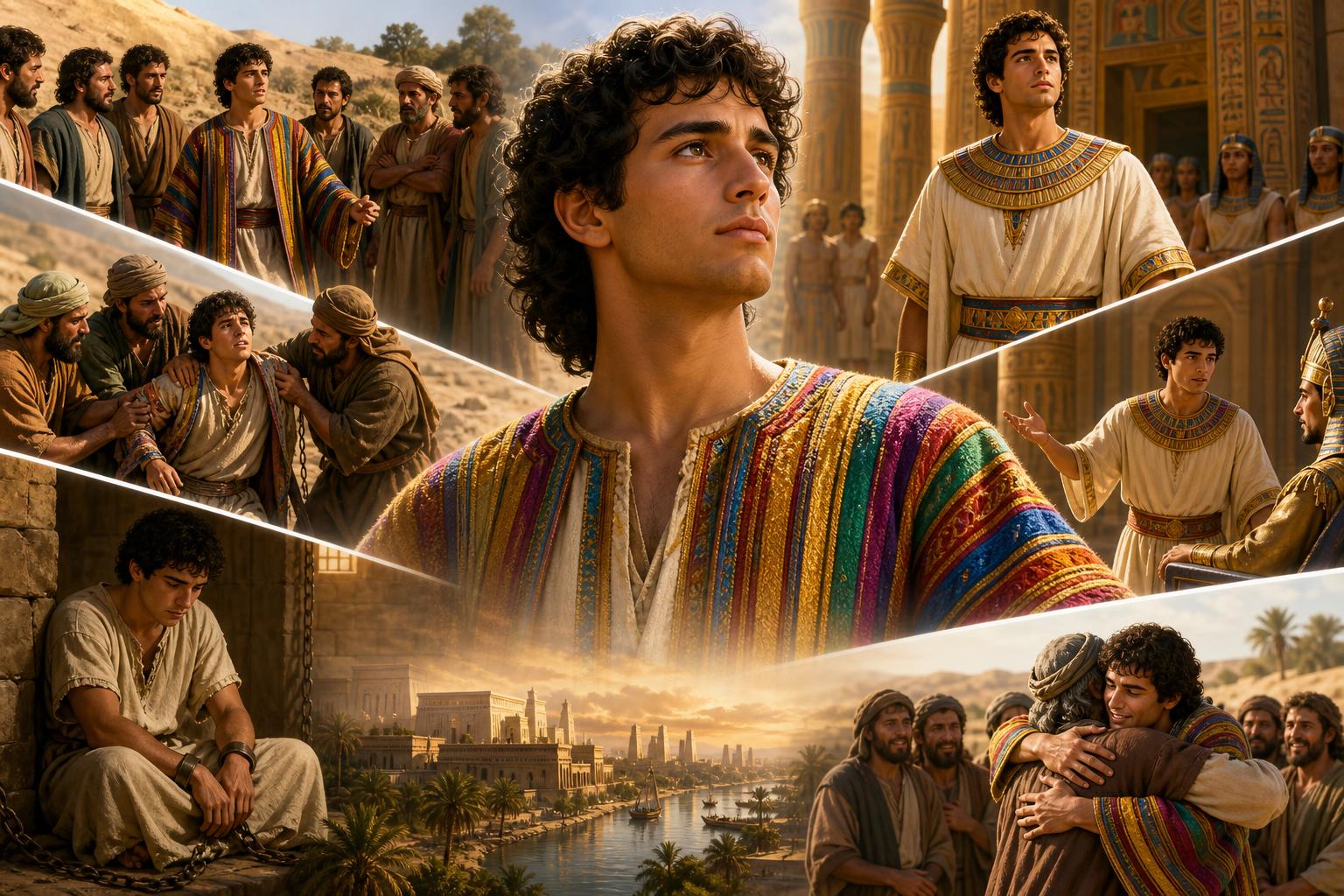
Here is a scannable timeline of Joseph’s life based on Genesis 37–50: – **Joseph is 17 and reports his dreams — Genesis 37:1–11:** Joseph tends his father’s flocks and receives a special robe from Jacob. His dreams suggest that members of his family will bow before him. – **Joseph is betrayed and sold — Genesis 37:12–36:** His brothers initially discuss killing him, but Joseph is ultimately sold to traveling merchants and taken to Egypt. The brothers deceive Jacob by presenting Joseph’s bloodstained robe. – **Joseph serves Potiphar — Genesis 39:1–6:** Potiphar, an Egyptian official, buys Joseph. The Lord is with Joseph, and he is placed in charge of the household. – **Joseph resists temptation and is imprisoned — Genesis 39:7–23:** Joseph refuses the sexual advances of Potiphar’s wife. After she falsely accuses him, Joseph is sent to prison. – **Joseph interprets prisoners’ dreams — Genesis 40:** Joseph explains the dreams of Pharaoh’s cupbearer and baker. His interpretations come true, but the restored cupbearer initially forgets him. – **Joseph interprets Pharaoh’s dreams at age 30 — Genesis 41:1–46:** Two years later, Joseph explains that Egypt will experience seven years of abundance followed by seven years of famine. Pharaoh appoints him to oversee preparations. – **Joseph stores grain and starts a family — Genesis 41:47–57:** During the plentiful years, Joseph stores food. His sons Manasseh and Ephraim are born before the famine. – **Joseph’s brothers travel to Egypt — Genesis 42–44:** The famine drives Joseph’s brothers to buy grain. They do not recognize Joseph, and a series of tests exposes their guilt and reveals their growing concern for Benjamin and Jacob. – **Joseph reveals his identity — Genesis 45:** After Judah offers himself in Benjamin’s place, Joseph weeps and identifies himself. He invites the whole family to live in Egypt. – **Jacob’s family settles in Egypt — Genesis 46–47:** Jacob travels to Egypt and reunites with Joseph. The family settles in the region of Goshen. – **Jacob blesses Joseph’s sons and dies — Genesis 48–49:** Jacob blesses Ephraim and Manasseh, speaks over his sons, and dies after living in Egypt for 17 years. – **Joseph reassures his brothers and later dies — Genesis 50:** After Jacob’s death, the brothers fear retaliation. Joseph promises to care for them, points to God’s preserving purpose, and eventually dies at age 110.
Joseph and His Brothers: A Chapter-by-Chapter Summary
**Genesis 37: Jealousy and betrayal** Joseph is one of Jacob’s younger sons and the firstborn son of Rachel. Jacob’s special treatment of Joseph, combined with Joseph’s dreams, intensifies his brothers’ hatred. While Joseph visits them near Dothan, they strip off his robe and throw him into a pit. He is sold and carried to Egypt, while Jacob is led to believe that a wild animal killed him. **Genesis 38: Judah and Tamar** The narrative pauses Joseph’s story to recount Judah’s failure toward Tamar. This chapter contributes to the larger family story and provides important background for Judah’s later transformation. **Genesis 39–40: Faithfulness in slavery and prison** Joseph prospers in Potiphar’s household because the Lord is with him. He refuses Potiphar’s wife, explaining that sinning against his master would also be sinning against God. Her false accusation leads to imprisonment. Even there, Joseph receives responsibility and interprets the dreams of two royal officials. **Genesis 41: From prisoner to ruler** When Pharaoh has troubling dreams, the cupbearer remembers Joseph. Joseph makes clear that interpretation belongs to God. He predicts seven abundant years and seven famine years, then recommends an organized food-storage plan. Pharaoh recognizes his wisdom and appoints him over Egypt. **Genesis 42–44: The brothers are tested** Joseph’s brothers come to Egypt for grain and bow before him, echoing his earlier dreams. Joseph recognizes them, but they do not recognize him. He questions and tests them, requiring them to bring Benjamin to Egypt. When Joseph’s silver cup is found in Benjamin’s sack, Judah pleads for Benjamin and offers to remain as a slave in his place. **Genesis 45–47: Recognition and reunion** Moved by Judah’s appeal, Joseph reveals his identity. He interprets his arrival in Egypt through the lens of God’s preserving work and tells his brothers not to be distressed. Jacob’s household moves to Egypt, where father and son are reunited. **Genesis 48–50: Blessing, death, and reassurance** Jacob blesses Joseph’s sons and adopts Ephraim and Manasseh into the tribal inheritance. After Jacob dies, Joseph’s brothers worry that he will finally seek revenge. Joseph weeps, reassures them, and commits to providing for their families. He dies trusting that God will eventually bring Israel back to the land promised to Abraham, Isaac, and Jacob.
Genesis 37–50 Explained: Major Themes
**God’s providence** Genesis repeatedly states that the Lord was with Joseph, especially during his years in Potiphar’s household and prison (Genesis 39:2, 21, 23). Joseph later recognizes that God worked through events intended for harm to preserve life (Genesis 45:5–8; 50:20). This does not excuse the brothers’ wrongdoing. Instead, the narrative holds human responsibility and God’s preserving purpose together. **Integrity under pressure** Joseph’s refusal of Potiphar’s wife shows moral conviction when obedience is costly. He has no visible advantage to gain by refusing, yet he will not betray his master or sin against God (Genesis 39:9). **Faithfulness in waiting** Joseph’s rise does not happen immediately. He serves as a slave, experiences false accusation, and remains imprisoned after the cupbearer forgets him. The story does not portray waiting as easy, but it shows Joseph using his abilities faithfully in each setting. **Wisdom and stewardship** Joseph does more than interpret Pharaoh’s dreams. He proposes a practical response to the coming crisis. His careful administration during abundance prepares Egypt and surrounding peoples for famine. **Guilt, repentance, and change** The brothers remember their treatment of Joseph when trouble comes upon them (Genesis 42:21). Judah, who once participated in selling Joseph, later offers himself in Benjamin’s place (Genesis 44:18–34). His action provides strong narrative evidence of changed priorities. **Forgiveness and reconciliation** Joseph does not retaliate when he gains power. He forgives, provides for his family, and offers reassurance. At the same time, the story shows that reconciliation is not merely pretending the betrayal never occurred. Joseph brings hidden guilt into the open and looks for evidence that his brothers have changed.
Key Lessons from the Life of Joseph
1. **Present suffering does not reveal the whole story.** Joseph could not see how slavery or imprisonment would lead to the preservation of his family. Readers are encouraged to remain faithful without assuming that every hardship will be quickly explained. 2. **Integrity matters even when no one seems to reward it.** Joseph chooses obedience in private and continues serving responsibly after injustice. 3. **God-given abilities should serve others.** Joseph uses discernment, administration, and leadership to prepare for famine and preserve life. 4. **Authority creates an opportunity to protect rather than retaliate.** Joseph has the power to punish his brothers, but he uses his position to feed and restore his family. 5. **Forgiveness rejects personal revenge.** Joseph does not deny that his brothers intended evil. He names the wrong truthfully while refusing to answer evil with evil. 6. **Reconciliation may involve truth and demonstrated change.** Joseph’s testing of his brothers reveals whether they will abandon Benjamin as they once abandoned him. 7. **God’s providence does not make evil behavior acceptable.** Genesis 50:20 distinguishes between the brothers’ harmful intention and God’s life-preserving intention. 8. **Faith can look beyond one lifetime.** Before his death, Joseph expresses confidence that God will visit Israel and bring the people out of Egypt (Genesis 50:24–25; compare Exodus 13:19).
What the Bible States—and What Later Tradition Adds
A careful Joseph Bible study guide should separate details in Genesis from later assumptions and traditions. – **The special garment:** Genesis 37 describes Jacob giving Joseph a distinctive robe. Translations variously render it as a “robe of many colors,” “ornate robe,” or “long robe with sleeves.” The Hebrew expression is difficult, so its exact appearance is uncertain. – **The merchants:** Genesis 37 refers to Ishmaelites and Midianites within the account. Interpreters explain the relationship between these labels in different ways, but the central point is clear: Joseph is sold and taken to Egypt. – **Potiphar’s wife:** The Bible does not provide her name. Names assigned to her in later literature are not part of the Genesis text. – **The pharaoh:** Genesis does not identify the pharaoh by personal name. Proposed historical identifications are debated and should not be presented as explicit biblical facts. – **Joseph’s appearance:** Genesis says Joseph shaves and changes his clothes before meeting Pharaoh (Genesis 41:14), but detailed visual portrayals in art and film come from artistic imagination. – **Joseph’s exact age during every event:** Scripture says he is 17 near the beginning of the story and 30 when he enters Pharaoh’s service. The family arrives after seven years of abundance and two years of famine, making Joseph about 39 at the reunion. The text does not date every event with equal precision. These distinctions allow families and Bible classes to appreciate later retellings without confusing them with what Scripture explicitly records.
Joseph Bible Study and Discussion Questions
Use these questions for individual reflection, family reading, or a church small group: 1. According to Genesis 37, what factors contribute to the conflict between Joseph and his brothers? 2. What does Joseph’s response to Potiphar’s wife reveal about his view of sin and responsibility? 3. Where do you see evidence that God is with Joseph even before his circumstances improve? 4. Why does Joseph credit God when interpreting dreams in Genesis 40–41? 5. How does Joseph combine spiritual discernment with practical planning during the famine? 6. What signs of change appear in the brothers, especially Judah, in Genesis 42–44? 7. Why might Joseph test his brothers before revealing his identity? 8. What is the difference between forgiveness, trust, and reconciliation in this story? 9. How does Genesis 50:20 acknowledge both human evil and God’s providence? 10. Where might God be calling you to practice integrity, patience, wise stewardship, or forgiveness? For a shorter family lesson, read Genesis 45:1–15 and 50:15–21. Ask each person to identify what Joseph says about his brothers’ actions, God’s purpose, and his own response.
FAQs
What is the short summary of the story of Joseph in the Bible?
Joseph is betrayed by his jealous brothers and sold into slavery in Egypt. After faithful service, false accusation, and imprisonment, he interprets Pharaoh’s dreams and becomes a powerful administrator. During a famine, Joseph’s brothers come to Egypt for food. Joseph eventually reveals his identity, forgives them, reunites with Jacob, and provides for the family.
What is the main lesson of Joseph’s story?
A central lesson is that God can work through painful circumstances to accomplish preserving purposes without approving the evil choices that caused the pain. Joseph’s life also teaches integrity, patience, wise stewardship, forgiveness, and reconciliation. Genesis 50:20 expresses this theme most directly.
Did Joseph forgive his brothers immediately?
Joseph does not take revenge, but the narrative presents reconciliation as a process. Before revealing himself, he tests his brothers and observes their concern for Benjamin and Jacob. Judah’s willingness to sacrifice himself for Benjamin demonstrates meaningful change. Joseph then reveals his identity, comforts his brothers, and later reassures them again after Jacob’s death.
Go deeper in study
Use FaithPath resources for Bible study, reflection, and small-group discussion.

Leave a Reply