
Listen to this article
Joseph’s Story in the Bible: Timeline, Key Events, and Lessons
The Joseph story in the Bible begins with a favored young man whose dreams intensify conflict within his family. After his brothers sell him into slavery, Joseph is taken to Egypt, falsely accused, and imprisoned. God remains with him through these reversals, eventually raising him to a position of authority under Pharaoh. Joseph then helps Egypt survive a severe famine and faces the brothers who betrayed him. Genesis 37–50 presents a powerful account of providence, integrity, forgiveness, family reconciliation, and God’s ability to bring good through human wrongdoing without excusing the wrongdoing itself.
Key takeaways
- Joseph’s story appears primarily in Genesis 37–50 and unfolds over many years, from his youth in Canaan to his death in Egypt.
- Joseph experiences betrayal, slavery, false accusation, and imprisonment before becoming Egypt’s second-highest ruler.
- Joseph consistently recognizes God as the source of his ability to interpret dreams and understand events.
- His administration stores grain during seven abundant years, preparing Egypt and surrounding peoples for seven years of famine.
- Joseph tests his brothers before revealing himself, allowing him to see whether their character and treatment of Benjamin have changed.
- The story teaches integrity, patient faith, wise stewardship, forgiveness, and reconciliation while showing that forgiveness does not make evil actions acceptable.
Where Is Joseph’s Story Found in the Bible?
Joseph’s main story is recorded in Genesis 37–50. He is one of Jacob’s 12 sons and the first son born to Rachel, Jacob’s beloved wife (Genesis 30:22–24). Joseph’s life also connects the family narratives of Abraham, Isaac, and Jacob with Israel’s later experience in Egypt. Genesis 37 introduces Joseph’s dreams and betrayal. Genesis 39–41 follows his slavery, imprisonment, dream interpretations, and rise to power. Genesis 42–45 describes his encounters and reconciliation with his brothers. Genesis 46–50 records Jacob’s family settling in Egypt, Jacob’s final blessings and death, Joseph’s reassurance of his brothers, and Joseph’s own death. This Joseph should not be confused with Joseph, the husband of Mary, in the New Testament.
Joseph Bible Story Timeline
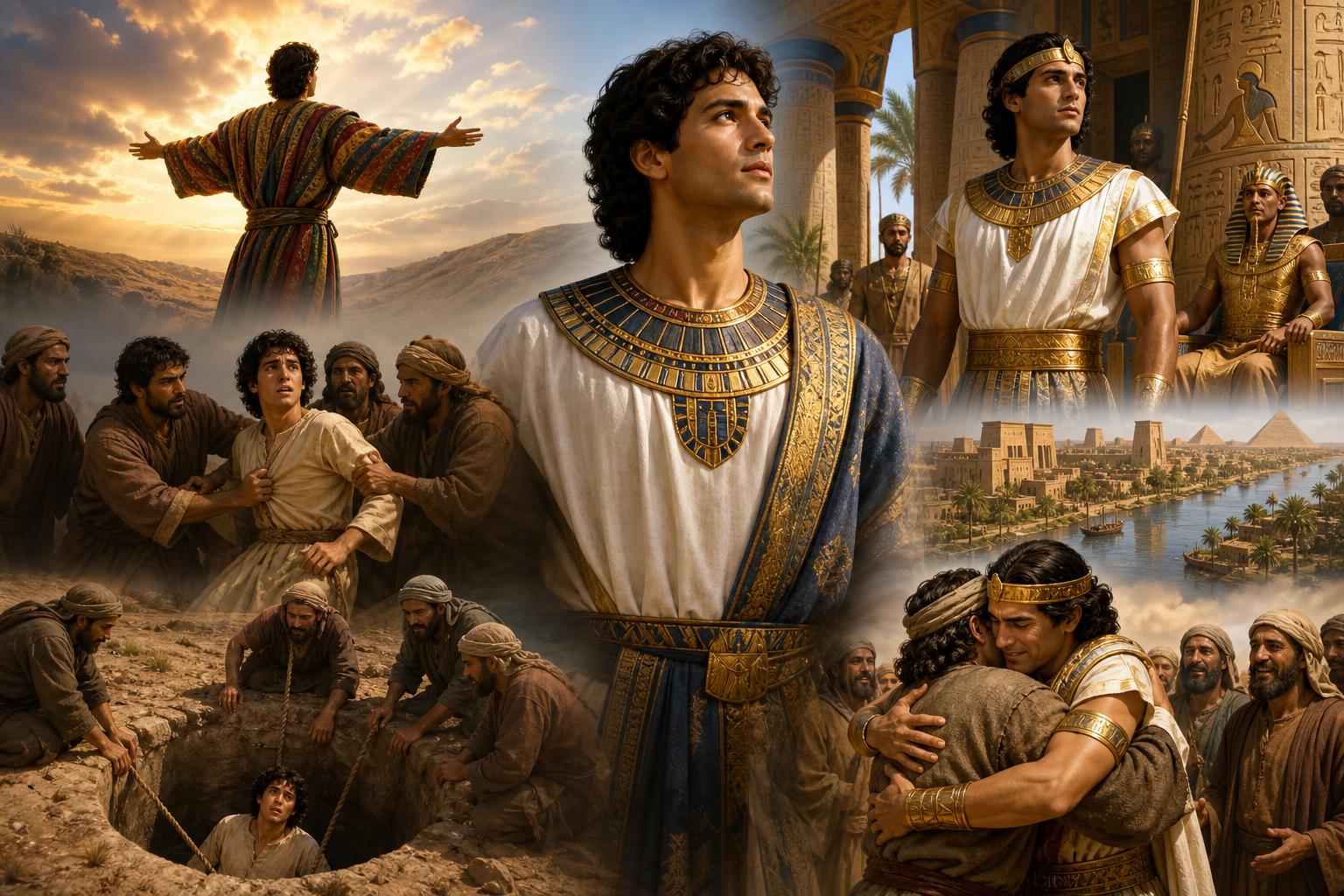
**Joseph at age 17 — Dreams and family conflict (Genesis 37:1–11):** Joseph tends his father’s flocks and reports poorly on some of his brothers. Jacob gives Joseph a special robe, communicating favored status. Joseph then recounts dreams in which his family appears to bow before him. His brothers respond with jealousy and hatred. **Betrayal and sale into slavery (Genesis 37:12–36):** When Joseph visits his brothers near Dothan, they initially plot to kill him. Reuben intervenes, and Joseph is placed in a pit. While Reuben is absent, the others sell Joseph to traveling merchants for 20 shekels of silver. They deceive Jacob by dipping Joseph’s robe in goat’s blood, leading him to believe that a wild animal killed his son. **Service in Potiphar’s house (Genesis 39:1–6):** Joseph is sold to Potiphar, an Egyptian official. The Lord is with Joseph, and Potiphar observes that his household prospers under Joseph’s management. He entrusts nearly everything to Joseph. **False accusation and imprisonment (Genesis 39:7–23):** Potiphar’s wife repeatedly tries to seduce Joseph. Joseph refuses, explaining that the act would betray his master and be a sin against God. When he escapes from her, leaving his garment behind, she falsely accuses him. Joseph is imprisoned, but the Lord remains with him and grants him favor with the prison keeper. **Dreams in prison (Genesis 40):** Joseph interprets the dreams of Pharaoh’s cupbearer and baker. His interpretations come true: the cupbearer is restored, while the baker is executed. Although Joseph asks the cupbearer to remember him, the man forgets him for two years. **Joseph before Pharaoh at age 30 (Genesis 41):** Pharaoh dreams about seven healthy cows consumed by seven thin cows and seven healthy heads of grain swallowed by seven thin heads. The cupbearer remembers Joseph. Joseph tells Pharaoh that interpretation belongs to God, then explains that the dreams predict seven abundant years followed by seven years of famine. Pharaoh appoints Joseph to oversee preparations, making him second in authority. Joseph stores grain throughout Egypt. **Marriage and children (Genesis 41:45–52):** Joseph marries Asenath and has two sons, Manasseh and Ephraim. Their names reflect Joseph’s testimony that God has sustained him through hardship and made him fruitful in Egypt. **The famine and his brothers’ visits (Genesis 42–44):** The famine reaches Canaan, so Jacob sends 10 sons to Egypt to buy grain while keeping Benjamin at home. The brothers bow before Joseph without recognizing him, fulfilling the pattern of Joseph’s earlier dreams. Joseph questions and tests them, detains Simeon, and requires them to return with Benjamin. During a later visit, Joseph arranges for his silver cup to be found in Benjamin’s sack. Judah offers himself in Benjamin’s place, demonstrating responsibility and changed character. **Joseph reveals his identity (Genesis 45):** Overcome with emotion, Joseph tells his brothers who he is. He acknowledges their harmful intent but also recognizes that God has worked through the events to preserve life. Joseph invites Jacob and the entire household to live in Egypt. **Jacob’s family settles in Egypt (Genesis 46–47):** Jacob travels to Egypt after receiving divine reassurance. Pharaoh permits the family to settle in Goshen, where they can care for their livestock. Joseph continues administering food during the famine. **Final blessings and deaths (Genesis 48–50):** Jacob blesses Joseph’s sons, Ephraim and Manasseh, and speaks blessings over his own sons. After Jacob dies, Joseph’s brothers fear retaliation. Joseph reassures them, weeps with them, and continues providing for their families. Joseph dies at age 110, expressing confidence that God will one day bring Israel out of Egypt and asking that his bones be carried with them.
Joseph and His Brothers: Betrayal, Testing, and Reconciliation
The Joseph and his brothers summary is not simply a quick movement from betrayal to forgiveness. Genesis portrays reconciliation as a process involving truth, accountability, demonstrated change, mercy, and renewed relationship. When Joseph’s brothers first arrive in Egypt, he recognizes them, but they do not recognize him (Genesis 42:6–8). Rather than immediately revealing himself, Joseph tests them. These tests revisit key features of their earlier sin: the vulnerability of a younger favored brother, their father’s grief, and the temptation to save themselves at someone else’s expense. Judah’s willingness to remain enslaved in Benjamin’s place marks a significant change (Genesis 44:18–34). Years earlier, the brothers had sold Joseph and allowed Jacob to grieve. Now Judah is prepared to sacrifice his own freedom rather than cause his father further sorrow. After witnessing this response, Joseph reveals his identity and weeps openly (Genesis 45:1–15). Joseph’s forgiveness does not deny the evil committed against him. In Genesis 50:20, he plainly says that his brothers intended harm. At the same time, he testifies that God brought a life-preserving outcome from what they had done. The resulting reconciliation includes honest acknowledgment of wrong, evidence of repentance, compassionate forgiveness, and practical care.
God’s Providence in Joseph’s Life
A repeated statement in the Joseph in Egypt Bible story is that “the Lord was with Joseph” (Genesis 39:2, 21, 23). God’s presence does not prevent Joseph from experiencing suffering, but it sustains him and gives purpose to his faithful service in difficult circumstances. The clearest summary appears in Joseph’s words to his brothers: “You meant evil against me, but God meant it for good” (Genesis 50:20). The verse holds two realities together. The brothers are responsible for their harmful intentions and actions, while God works through the larger sequence of events to preserve many lives. Christian traditions commonly affirm divine providence in this passage, although they may explain the relationship between God’s sovereignty and human responsibility in different ways. Some place greater emphasis on God’s comprehensive direction of history, while others place greater emphasis on genuine human freedom or divine permission. Readers should avoid using Joseph’s story to minimize abuse, injustice, or grief. The text condemns human wrongdoing even as it declares that evil cannot ultimately defeat God’s redemptive purposes.
Lessons From the Life of Joseph
**Remain faithful when circumstances are unfair.** Joseph serves diligently in Potiphar’s household and in prison. His faithfulness does not guarantee immediate relief, but it displays integrity independent of recognition or reward. **Resist temptation with clear convictions.** Joseph refuses Potiphar’s wife because adultery would betray his master and offend God (Genesis 39:8–9). His response shows the value of deciding moral boundaries before pressure intensifies. **Use gifts humbly.** When asked to interpret dreams, Joseph does not claim independent power. He directs attention to God as the giver of interpretation (Genesis 40:8; 41:16). **Combine spiritual insight with practical wisdom.** Joseph not only interprets Pharaoh’s dreams but also recommends a plan for collecting and storing grain. Faithful leadership includes planning, administration, and responsible use of resources. **Do not confuse delay with abandonment.** Joseph waits years between his betrayal and his rise to authority. Even the cupbearer forgets him. The narrative encourages patient trust without suggesting that waiting or suffering is easy. **Forgiveness acknowledges the truth.** Joseph names his brothers’ evil intention rather than pretending it never happened. Biblical forgiveness can coexist with honesty, wise boundaries, accountability, and a careful process of rebuilding trust. **Look for evidence of changed character.** Joseph’s tests reveal whether his brothers will abandon Benjamin as they once abandoned him. Judah’s self-sacrificial offer provides evidence that the family’s patterns are changing. **Use influence to preserve and serve.** Joseph’s authority gives him an opportunity to prepare for famine and protect many lives. Leadership in this story is a responsibility to steward resources for others, not merely a personal reward.
Questions for Personal, Family, or Group Study
1. How do favoritism and unresolved family tensions contribute to the events of Genesis 37? 2. What do Joseph’s decisions in Potiphar’s house reveal about his understanding of integrity? 3. Why does Joseph credit God when interpreting dreams? 4. What practical leadership qualities does Joseph demonstrate during the years of abundance and famine? 5. Why might Joseph have tested his brothers before revealing his identity? 6. What evidence suggests that Judah and the other brothers have changed? 7. How does Genesis 50:20 distinguish human evil from God’s good purposes? 8. What is the difference between forgiveness, restored trust, and reconciliation? 9. Which part of Joseph’s long period of waiting is most relevant to your present circumstances? 10. How can a family or church pursue reconciliation without ignoring harm or avoiding appropriate safeguards?
FAQs
What is a short summary of Joseph’s story in the Bible?
Joseph, Jacob’s favored son, is betrayed and sold into slavery by his jealous brothers. In Egypt, he serves Potiphar, resists temptation, is falsely accused, and is imprisoned. After interpreting Pharaoh’s dreams, Joseph becomes a ruler and prepares Egypt for famine. His brothers later come to buy food, and after testing their character, Joseph reveals himself, forgives them, and helps his entire family settle in Egypt.
How long does Joseph’s story cover?
Genesis introduces Joseph at age 17 and reports that he entered Pharaoh’s service at age 30. The seven abundant years then passed before the famine brought his brothers to Egypt. Joseph lived to age 110, so the full biblical account spans approximately 93 years of his life, although not every period is narrated in equal detail.
What is the main lesson of Joseph’s story?
Joseph’s story teaches that God can work through painful and unjust circumstances to accomplish good purposes, while people remain responsible for their choices. It also models integrity, perseverance, wise stewardship, truthful forgiveness, and reconciliation supported by genuine change. Christian traditions may describe the relationship between divine sovereignty and human responsibility differently, but the narrative affirms both God’s providential work and the reality of human wrongdoing.
Go deeper in study
Use FaithPath resources for Bible study, reflection, and small-group discussion.

Leave a Reply