
Listen to this article
The Good Samaritan Explained: Meaning, Context, and Lessons for Today
The Good Samaritan parable meaning centers on Jesus’ call to love our neighbor with costly, practical mercy. In Luke 10:25-37, a lawyer asks Jesus, “Who is my neighbor?” Jesus answers with a story that overturns social assumptions: a wounded man is ignored by religious insiders but rescued by a Samaritan, a person many Jewish listeners would have viewed with suspicion or hostility. The parable teaches that neighbor-love is not limited by ethnicity, religion, social boundary, convenience, or personal safety. Jesus moves the question from “Who qualifies as my neighbor?” to “Will I become a neighbor to the person in need?”
Key takeaways
- The Good Samaritan parable appears in Luke 10:25-37 and begins with a lawyer testing Jesus about inheriting eternal life.
- Jesus affirms the commands to love God and love neighbor, then tells the parable to expose the limits people often place on mercy.
- The Samaritan’s compassion would have surprised many first-century Jewish hearers because of deep Samaritan-Jewish tensions.
- The priest and Levite see the wounded man but pass by, while the Samaritan stops, risks involvement, and pays a personal cost.
- The main lesson is not merely to admire kindness but to practice costly compassion as part of faithful discipleship.
Luke 10:25-37 Explained: The Setting of the Parable
The parable of the Good Samaritan begins when a lawyer, an expert in the Law of Moses, stands up to test Jesus and asks, “Teacher, what shall I do to inherit eternal life?” (Luke 10:25). Jesus responds by asking what is written in the Law. The lawyer answers with two central commands: love the Lord your God with all your heart, soul, strength, and mind, and love your neighbor as yourself (Deuteronomy 6:5; Leviticus 19:18; Luke 10:27). Jesus says, “You have answered correctly; do this, and you will live” (Luke 10:28). But the lawyer then asks, “And who is my neighbor?” (Luke 10:29). Luke says he asks this because he wants to justify himself. In other words, the question is not only about information; it is about limits. He wants to know where neighbor-love begins and ends. Jesus answers not with a definition but with a story that challenges the heart.
What Happens in the Parable of the Good Samaritan?
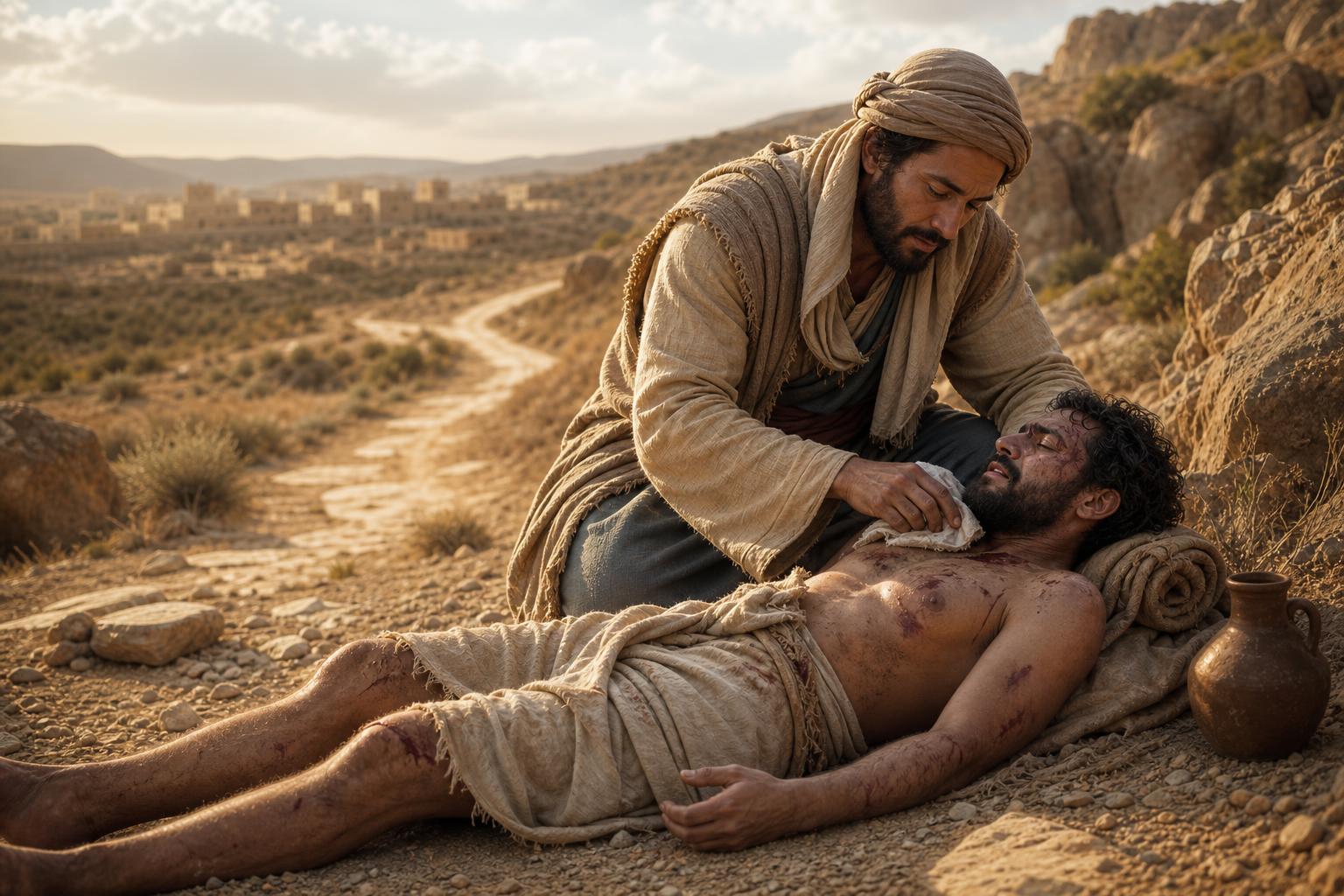
Jesus describes a man traveling from Jerusalem to Jericho, a road known for its danger and difficult terrain. Robbers attack him, strip him, beat him, and leave him half dead (Luke 10:30). A priest comes down the road, sees the man, and passes by on the other side. A Levite also sees him and passes by. These were respected religious figures, yet they do not stop to help. Then a Samaritan comes near. Unlike the others, he is moved with compassion. He goes to the wounded man, bandages his injuries, pours on oil and wine, places him on his own animal, takes him to an inn, and pays for his care (Luke 10:33-35). The Samaritan does not offer vague sympathy; he offers time, resources, inconvenience, and risk. Jesus ends by asking which of the three proved to be a neighbor. The lawyer answers, “The one who showed him mercy.” Jesus replies, “You go, and do likewise” (Luke 10:36-37).
Samaritan-Jewish Tensions in the First-Century Context
To understand the parable of the Good Samaritan context, it is important to know that Jews and Samaritans had a long history of religious, ethnic, and social conflict. Samaritans were connected to the northern kingdom of Israel but developed distinct religious practices, including worship centered on Mount Gerizim rather than Jerusalem. Many Jews in Jesus’ day viewed Samaritans as outsiders, compromised, or hostile. The New Testament reflects this tension in passages such as John 4:9, where the Samaritan woman is surprised that Jesus, a Jew, asks her for a drink. Against this background, Jesus’ choice of a Samaritan as the merciful hero of the story would have been startling. He does not make the respected religious figures the example of neighbor-love. Instead, he makes the despised outsider the one who embodies mercy. This reversal confronts prejudice and invites listeners to see compassion where they may least expect it.
Who Is My Neighbor in the Bible?
The lawyer asks, “Who is my neighbor?” but Jesus reshapes the issue. The lawyer’s question sounds like a request for boundaries: Who must I love, and who can I exclude? Jesus’ final question is different: “Which of these three, do you think, proved to be a neighbor?” (Luke 10:36). The shift is important. The focus moves from identifying who deserves love to becoming the kind of person who shows mercy. In the Bible, neighbor-love includes practical care for those near us, justice for the vulnerable, and mercy toward those we might naturally avoid. Jesus does not deny that relationships have different responsibilities, such as family, church, and community commitments. But he refuses to let love be narrowed by prejudice, convenience, or religious self-protection.
The Good Samaritan Parable Meaning for Discipleship
The Good Samaritan lesson for adults is deeply practical: true love of God expresses itself in mercy toward people in need. The priest and Levite may have had reasons for avoiding the wounded man, such as fear, busyness, ritual concerns, or concern for their own safety. Jesus does not explore their excuses. He highlights what they failed to do: they saw the man and did not act. The Samaritan’s compassion is costly. He interrupts his journey, touches the wounded man, uses his supplies, gives up his transportation, takes responsibility for ongoing care, and pays the innkeeper. Christian discipleship includes this kind of embodied love. It is not sentimental compassion only; it is mercy that crosses the road, comes near, and bears a cost.
Lessons for Today: Practicing Costly Compassion
The Good Samaritan parable invites Christians, families, and small groups to consider where mercy is being resisted or delayed. Today, the wounded person beside the road may be a lonely neighbor, an immigrant family, someone recovering from addiction, a person in financial crisis, a church member carrying grief, or someone we find difficult to love. The parable does not require reckless action in every situation, but it does call believers to reject indifference. Wisdom, safety, and healthy boundaries matter; so do compassion, generosity, and courage. Churches can apply this parable by building ministries that notice overlooked people, respond to urgent needs, and form disciples who see mercy as central to following Jesus.
Good Samaritan Bible Study Questions for Groups
Use these questions for reflection or small-group discussion: 1. Why do you think the lawyer wanted to justify himself when he asked, “Who is my neighbor?” 2. What excuses might the priest and Levite have used, and what excuses do people use today to avoid costly compassion? 3. Why would Jesus’ choice of a Samaritan as the hero have challenged his original audience? 4. What is the difference between feeling compassion and acting with compassion? 5. Who are the people your church or group may be tempted to overlook? 6. What is one practical way you can “go and do likewise” this week?
FAQs
What is the Good Samaritan parable meaning in simple terms?
The Good Samaritan parable means that love for God must be expressed in practical mercy toward people in need. Jesus teaches that a true neighbor is not defined by social boundaries but by compassionate action.
Why did Jesus use a Samaritan in the story?
Jesus used a Samaritan because Jews and Samaritans often had deep hostility toward each other. By making the Samaritan the merciful example, Jesus challenged prejudice and showed that God-honoring compassion may come from someone the audience is tempted to reject.
How can Christians apply the Good Samaritan today?
Christians can apply the parable by noticing people in need, resisting indifference, crossing social barriers, and offering practical help. Application may include caring for the sick, welcoming outsiders, supporting those in crisis, and building church ministries shaped by mercy.
Go deeper in study
Use FaithPath resources for Bible study, reflection, and small-group discussion.

Leave a Reply