
Listen to this article
David and Goliath Bible Story: Summary, Scripture, Meaning, and Discussion Questions
The David and Goliath Bible story summary begins in 1 Samuel 17, where a young shepherd named David faces the Philistine giant Goliath while Israel’s army trembles in fear. David does not win because he is bigger, stronger, or better equipped. He wins because he trusts the living God, remembers God’s past faithfulness, and acts with courage when others are afraid. For parents, teachers, and church leaders, this story offers a powerful way to teach courage, humility, faith under pressure, and dependence on God rather than human strength.
Key takeaways
- The David and Goliath story is found in 1 Samuel 17 and centers on faith in God during a moment of public fear and pressure.
- David’s courage grows from remembering how God helped him protect his sheep from lions and bears.
- Goliath trusts in size, weapons, and intimidation, while David trusts in the name of the Lord Almighty.
- The story is not mainly about self-confidence; it is about God’s power working through a humble and faithful servant.
- A helpful David and Goliath lesson for kids should emphasize courage, trust in God, humility, and doing what is right even when others are afraid.
David and Goliath Bible Story Summary
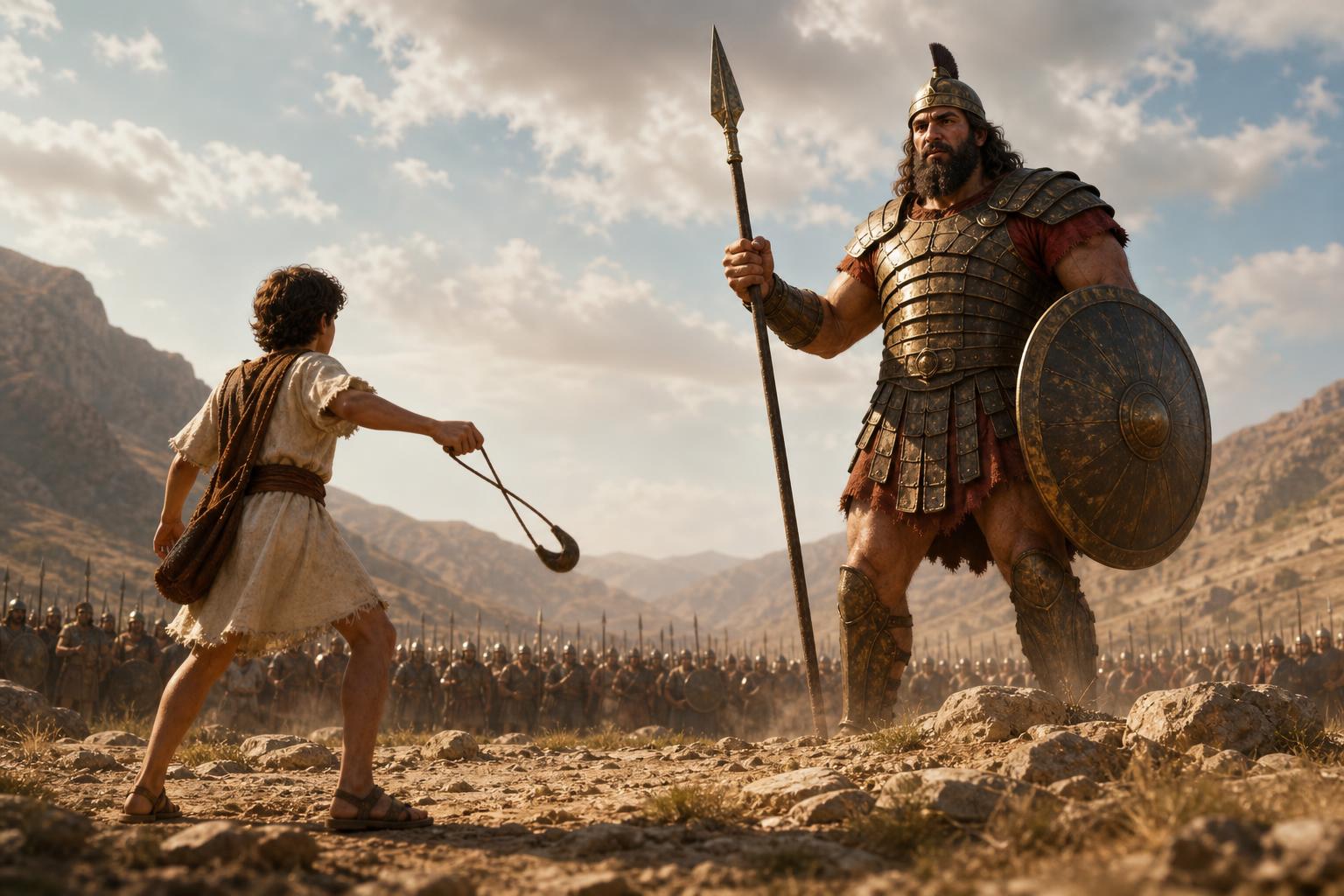
In 1 Samuel 17, the Israelites and Philistines are gathered for battle. The Philistines have a champion named Goliath from Gath, described as a giant warrior with heavy armor, a large spear, and a terrifying presence. For forty days, Goliath challenges Israel, asking for one man to fight him. If Israel’s champion wins, the Philistines will serve Israel; if Goliath wins, Israel will serve the Philistines. King Saul and the Israelite army are afraid. David, the youngest son of Jesse, is not a soldier at this point. He is a shepherd who comes to the battlefield to bring food to his older brothers and check on them. When David hears Goliath insulting Israel and defying the armies of the living God, he is troubled that no one is willing to stand against him. David tells Saul that he will fight Goliath. Saul doubts him because David is young and Goliath has been a warrior for years. David explains that while tending sheep, God helped him defeat lions and bears. David believes the same God will deliver him from Goliath. Saul offers David armor, but David is not used to it. Instead, David takes his shepherd’s staff, five smooth stones, and a sling. Goliath mocks David when he sees him. But David answers with faith: “You come against me with sword and spear and javelin, but I come against you in the name of the Lord Almighty” (1 Samuel 17:45). David runs toward the battle line, uses his sling, and strikes Goliath in the forehead with a stone. Goliath falls, and David defeats him. The Israelites then gain courage and pursue the Philistines.
Key Scripture References in 1 Samuel 17
The main account of David and Goliath is found in 1 Samuel 17. Several verses are especially important for teaching and discussion. 1 Samuel 17:11 shows the fear of Saul and Israel: “On hearing the Philistine’s words, Saul and all the Israelites were dismayed and terrified.” This helps readers understand the pressure David enters. 1 Samuel 17:37 records David’s confidence in God’s past faithfulness: “The Lord who rescued me from the paw of the lion and the paw of the bear will rescue me from the hand of this Philistine.” David’s faith is not reckless; it is rooted in what he has already seen God do. 1 Samuel 17:45 gives the heart of the story: David does not come in his own strength but “in the name of the Lord Almighty.” This verse is central for explaining the David and Goliath meaning for Christians. 1 Samuel 17:47 declares the theological point: “The battle is the Lord’s.” This does not mean people do nothing; David acts boldly. But it does mean victory ultimately belongs to God, not to human weapons, status, or size.
Meaning of David and Goliath for Christians
For Christians, the David and Goliath Bible story is more than an underdog story. It teaches that God’s people are called to trust Him when circumstances look impossible. David is small compared with Goliath, but Goliath is small compared with God. The story also shows the difference between outward appearance and inward faith. Earlier in 1 Samuel 16, God tells Samuel that people look at outward appearance, but the Lord looks at the heart (1 Samuel 16:7). David’s victory follows that theme. He is overlooked by others, but his heart is devoted to God. Christians have sometimes also read David as a picture of the kind of deliverer God provides: one representative who wins a victory for the people. Some Christian teachers connect this theme to Christ, who defeats sin and death on behalf of His people. This should be taught carefully and with attention to the original Old Testament setting, but it can be a meaningful connection in Christian formation. The story encourages believers to face fear with faith, but it should not be reduced to “you can defeat any giant if you try hard enough.” David’s hope is not in positive thinking. His hope is in the living God.
Common Misconceptions About David and Goliath
One common misconception is that the story is mainly about believing in yourself. David is courageous, but his confidence is not self-centered. He repeatedly points to the Lord as the one who rescues and gives victory. Another misconception is that David acted foolishly or impulsively. The text shows David drawing from real experience. As a shepherd, he had protected his flock from dangerous animals. He knew how to use a sling, and he chose the tools he had practiced with rather than Saul’s unfamiliar armor. A third misconception is that Goliath’s size is the only important detail. Goliath’s intimidation matters, but his deeper problem is that he defies the living God. The conflict is spiritual and covenantal, not merely physical. A fourth misconception is that the story guarantees believers will always win visible victories in the way they expect. Christians should avoid using this story to promise health, success, or triumph in every circumstance. The passage teaches God’s power, faithfulness, and authority, while the broader Bible also teaches endurance, suffering, and trust when outcomes are difficult.
Practical Applications for Families and Churches
For children, the David and Goliath lesson can focus on courage and faith: God can help us do what is right even when we feel small or afraid. Children can identify examples such as telling the truth, standing up for someone being treated unfairly, praying when afraid, or obeying God when it is unpopular. For teens and adults, the story invites reflection on fear, pressure, and identity. Saul and the army are paralyzed by what they see. David responds from what he knows about God. This contrast can help small groups discuss how fear can grow when people focus only on visible circumstances. For ministry leaders, the story is useful for teaching that God often works through unexpected people. David is young, overlooked, and not dressed like a warrior. Yet he is faithful with what God has given him. This can encourage churches to value children, youth, volunteers, and quiet servants whose faith may be stronger than their public status. Share Scriptures provides Bible story summaries and discussion guides that help families, teachers, and small groups move from retelling the story to applying it wisely and faithfully.
David and Goliath Discussion Questions
Use these David and Goliath discussion questions for family devotions, Sunday school, children’s ministry, or small groups. 1. What made Goliath frightening to Saul and the Israelite army? 2. Why do you think David responded differently from the soldiers? 3. What past experiences helped David trust God in this new challenge? 4. Why did David choose not to wear Saul’s armor? 5. What does 1 Samuel 17:45 teach us about David’s confidence? 6. What are some “giants” people face today, such as fear, temptation, peer pressure, injustice, or discouragement? 7. How can we avoid making this story only about self-confidence? 8. What is one situation this week where you need to trust God and do what is right? 9. How can a family, class, or church encourage people who feel small or overlooked? 10. What does this story teach us about God’s power and faithfulness?
FAQs
What is the short summary of the David and Goliath Bible story?
In 1 Samuel 17, Goliath challenges Israel’s army and terrifies them. David, a young shepherd, trusts God and agrees to fight him. Refusing Saul’s armor, David uses a sling and a stone to defeat Goliath, showing that the battle belongs to the Lord.
What does David and Goliath teach children?
The story teaches children that courage comes from trusting God, not from being the biggest or strongest. It also teaches humility, faithfulness in small responsibilities, and doing what is right even when others are afraid.
Is David and Goliath only an underdog story?
No. While David is physically smaller and less equipped than Goliath, the biblical focus is not merely on an underdog victory. The main message is that David trusts the living God, and God gives victory in a situation where human strength seems insufficient.
Go deeper in study
Use Share Scriptures resources for Bible study, reflection, and small-group discussion.

Leave a Reply