
Listen to this article
David and Goliath Bible Story: Meaning, Lessons, and Study Questions
The David and Goliath Bible story explained in 1 Samuel 17 is not primarily a lesson about believing in yourself or defeating any obstacle through determination. It is a biblical account of God delivering Israel through David, an unlikely and faithful servant who trusts the Lord’s power and seeks the Lord’s honor. Set during Israel’s conflict with the Philistines, the story contrasts Goliath’s intimidating appearance, Saul’s fearful leadership, and David’s confidence in the living God. For individuals, families, and small groups, the narrative offers enduring lessons about faith, courage, spiritual perspective, preparation, and giving glory to God.
Key takeaways
- David’s confidence rested in the Lord’s proven faithfulness, not in his own strength, skill, or status.
- Goliath’s challenge concerned God’s honor and Israel’s covenant identity, not merely David’s personal reputation.
- The narrative contrasts outward appearance with faithful character, continuing a theme introduced when David is anointed in 1 Samuel 16.
- David used skills developed through ordinary faithfulness as a shepherd, showing that trust in God and responsible preparation belong together.
- The victory advanced David’s role in Israel while exposing Saul’s fear and ineffective leadership.
- Christian readers often see David’s victory as anticipating Christ’s greater victory, although responsible interpretation begins with the passage’s original narrative context.
David and Goliath Summary
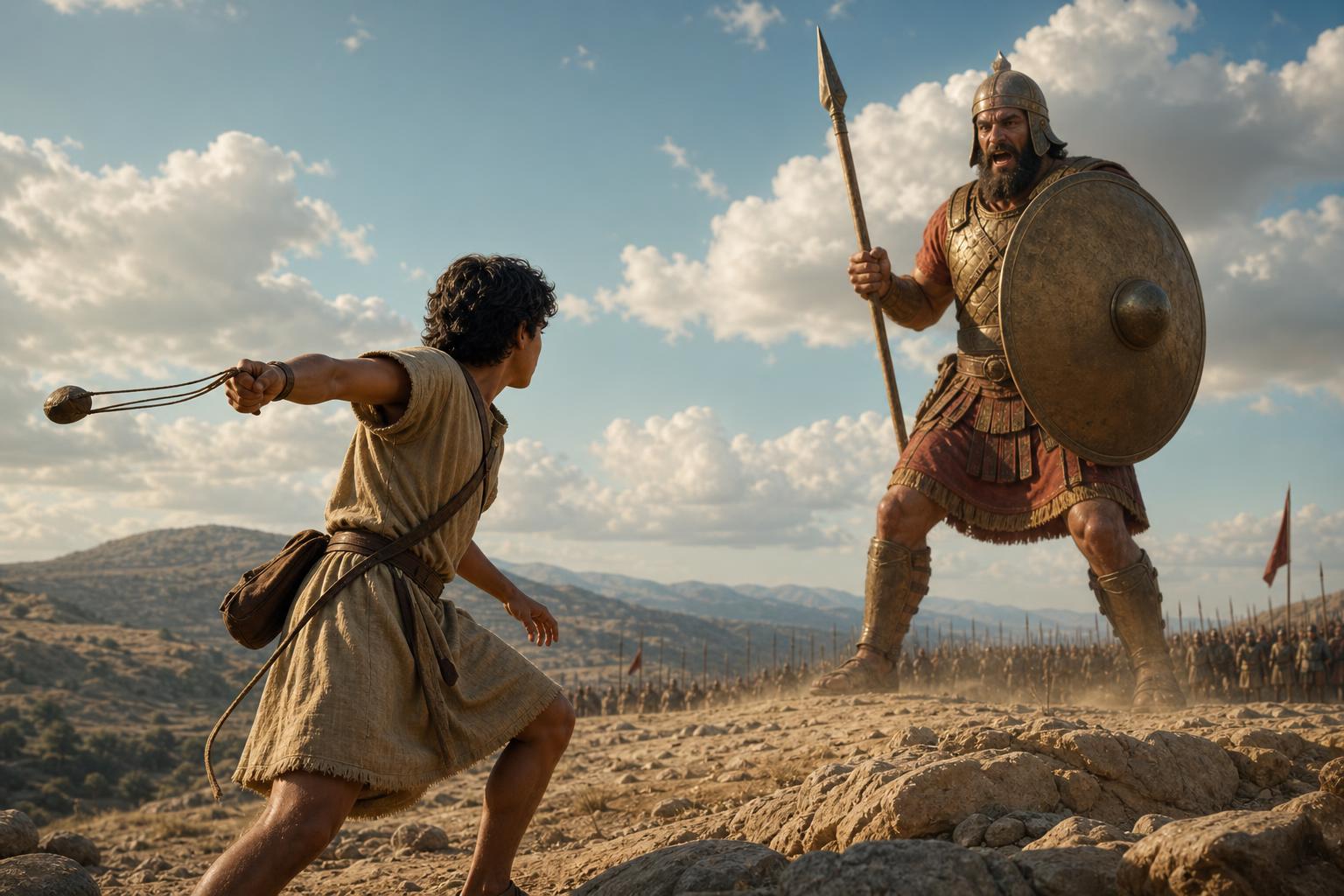
First Samuel 17 opens with the Philistine and Israelite armies positioned on opposite sides of the Valley of Elah. A Philistine champion named Goliath challenges Israel to send one warrior for single combat. If Israel’s representative wins, the Philistines will serve Israel; if Goliath wins, Israel must serve the Philistines (1 Samuel 17:8–10). For forty days, Goliath repeats his challenge while Saul and the Israelite army respond with fear. David, the youngest son of Jesse, arrives from Bethlehem to bring food to his brothers and supplies to their commander. When David hears Goliath defy Israel, he interprets the situation spiritually: Goliath has challenged “the armies of the living God” (1 Samuel 17:26). David volunteers to fight. He tells Saul that God previously delivered him from a lion and a bear while he protected his father’s sheep. Saul offers David armor, but David declines because he has not tested it. Carrying his staff, sling, and five smooth stones, David approaches Goliath in the name of the Lord. One stone strikes Goliath’s forehead, and David uses Goliath’s sword to complete the victory. The Philistine army flees, and Israel pursues it.
The Narrative and Historical Context of 1 Samuel 17
The battle occurs during a period of continuing conflict between Israel and the Philistines. The Valley of Elah lay in the border region between Philistine territory and the hill country associated with Judah. Control of this area had military and economic importance. Goliath is presented as a heavily armed champion whose height, armor, spear, and shield-bearer create an overwhelming visual impression (1 Samuel 17:4–7). His equipment represents the military strength that Israel fears. David appears to be his opposite: young, inexperienced in formal warfare, and equipped like a shepherd rather than a professional soldier. The story also belongs within the larger transition from Saul’s kingship to David’s rise. In 1 Samuel 16, God rejects Saul’s dynasty and directs Samuel to anoint David. God reminds Samuel that people look at outward appearance, but the Lord looks at the heart (1 Samuel 16:7). Chapter 17 illustrates that contrast. Saul is physically impressive and should lead Israel, yet he is afraid. David lacks conventional status but responds with faith in God. Ancient champion warfare provides the setting for Goliath’s proposal, but the outcome becomes a full battle rather than a permanently binding agreement between two representatives. After Goliath falls, the Philistines flee and Israel wins a decisive victory.
What Does the David and Goliath Story Mean?
At the center of the story is the reputation and saving power of God. David does not say that he will win because he is naturally fearless. He declares, “The battle is the Lord’s” (1 Samuel 17:47). His concern is that all people may know there is a God in Israel and that the Lord does not depend on conventional weapons to save (1 Samuel 17:46–47). This keeps the passage from becoming a generic message of self-confidence. David’s courage is God-centered confidence formed through previous experiences of divine faithfulness. He remembers how God delivered him while he guarded sheep and applies that history to the present danger. The story also contributes to the biblical account of David’s rise as Israel’s future king. He acts as the representative Saul fails to be, faces Israel’s enemy, and brings deliverance to God’s people. His victory is therefore both personal and national, but it ultimately points beyond David to the Lord who grants victory. Many Christians also read David as a pattern that anticipates Jesus Christ, the greater anointed King who defeats the enemies God’s people cannot defeat for themselves. This Christ-centered reading is especially common in typological interpretation. Christian traditions may differ over how directly individual story details should be connected to Christ, so readers should avoid assigning symbolic meanings to every object—such as the five stones—without textual support.
Lessons from David and Goliath
**1. Faith focuses on who God is.** Israel sees Goliath’s size and weapons; David sees a created man defying the living God. Biblical faith does not deny danger. It evaluates danger in light of God’s character and power. **2. Courage can grow through ordinary faithfulness.** David’s years as a shepherd prepared him to protect others, use a sling, and trust God under pressure. Seemingly unnoticed responsibilities can form character for later service. **3. Preparation does not compete with trust.** David trusts God, but he also uses a tested skill and selects appropriate stones. The narrative does not celebrate carelessness. Faithful action may include practice, wisdom, and the responsible use of available means. **4. Outward strength can be misleading.** Goliath’s armor and Saul’s stature make strong impressions, but neither guarantees faithful leadership. God’s purposes are not limited by human standards of influence, age, status, or appearance. **5. God’s honor matters more than personal recognition.** David repeatedly frames the conflict around Goliath’s defiance of God. Christian courage should seek the Lord’s glory rather than applause or personal importance. **6. Past faithfulness can strengthen present trust.** David remembers previous deliverance from the lion and bear. Remembering God’s work through Scripture and personal experience can encourage believers without creating a guarantee that every situation will end exactly as they expect.
Applying the Story Without Misusing It
A common application labels every difficulty a “Goliath” and assumes enough confidence will produce success. That approach can overlook the story’s main emphasis: God delivers his people and establishes his chosen servant. Christians are not promised an easy or immediate victory over every illness, conflict, financial problem, or opponent. A more faithful application asks how believers can honor God, remember his character, act courageously, and use their responsibilities and abilities wisely. It also recognizes that courage may involve endurance rather than dramatic success. The New Testament presents faithful believers who experienced both deliverance and suffering (Hebrews 11:32–40). Parents and teachers can help children understand that David was not powerful because he imagined himself to be unstoppable. He acted courageously because he knew the Lord was greater than Goliath. Adult studies can explore the story’s political and theological dimensions, including Saul’s failed leadership, David’s developing kingship, and the representative nature of the battle.
David and Goliath Discussion Questions
1. What details in 1 Samuel 17 make Goliath appear unbeatable from a human perspective? 2. How do Saul, the Israelite army, David’s brothers, and David respond differently to the challenge? 3. What does David’s language in 1 Samuel 17:26, 36, 45–47 reveal about his main concern? 4. How does 1 Samuel 16:7 help explain the contrast between David, Saul, and Goliath? 5. What role do David’s experiences with the lion and bear play in his decision to fight? 6. Why does David reject Saul’s armor? What does this decision teach—and what does it not teach? 7. How does the statement “the battle is the Lord’s” shape the meaning of the story? 8. In what ways does David act as Israel’s representative? 9. How can Christians apply this account without assuming God will remove every problem immediately? 10. Where might God be using an ordinary responsibility to develop faithfulness, wisdom, or courage in your life? 11. What is the difference between confidence in God and confidence in ourselves? 12. How might this passage encourage a church or ministry team facing opposition, limited resources, or fear?
A Simple 1 Samuel 17 Study Guide
**Read:** Begin with 1 Samuel 16:1–13 to understand David’s anointing, then read all of 1 Samuel 17. **Observe:** List repeated words and themes, especially references to fear, defiance, the living God, deliverance, and the Lord’s name. Compare how the narrator describes Goliath with how David describes him. **Interpret:** Ask what the passage reveals about God, David, Saul, Israel, and leadership. Identify the narrative problem, turning point, and resolution before moving to personal application. **Connect:** Compare 1 Samuel 17:47 with Psalm 20:7 and Zechariah 4:6. For a Christian canonical connection, consider how Jesus brings victory as God’s anointed King while avoiding forced parallels between every detail. **Apply:** Choose one action shaped by the passage: remember a specific example of God’s faithfulness, address a fear through prayer, prepare responsibly for a difficult duty, or encourage someone whose abilities are being underestimated. **Pray:** Ask God for courage rooted in his character, wisdom to act faithfully, humility to reject self-glory, and perseverance when deliverance does not come in the way expected.
FAQs
What is the main message of the David and Goliath Bible story?
The main message is that the Lord is able to save his people through an unlikely but faithful servant. David’s victory honors God and demonstrates that deliverance does not depend on visible strength or conventional weapons. The story encourages courage and faithful action, but it should not be reduced to a promise that self-confidence will defeat every personal obstacle.
Why did David take five smooth stones if he used only one?
First Samuel 17 does not explain why David selected five stones. The simplest interpretation is that he prepared responsibly by taking multiple suitable projectiles. Popular claims that the stones symbolized five virtues or were intended for Goliath’s relatives go beyond what this passage explicitly says.
How can adults use these David and Goliath discussion questions?
Adults can read 1 Samuel 16:1–13 and 1 Samuel 17, divide the questions into observation, interpretation, and application, and discuss how the story contrasts human appearance with trust in God. Small-group leaders should keep the focus on God’s deliverance, David’s role in Israel’s story, and careful application rather than treating every hardship as a guaranteed victory.
Go deeper in study
Use Share Scriptures resources for Bible study, reflection, and small-group discussion.

Leave a Reply