
Listen to this article
Jonah and the Great Fish: The Full Bible Story and Why Its Ending Matters
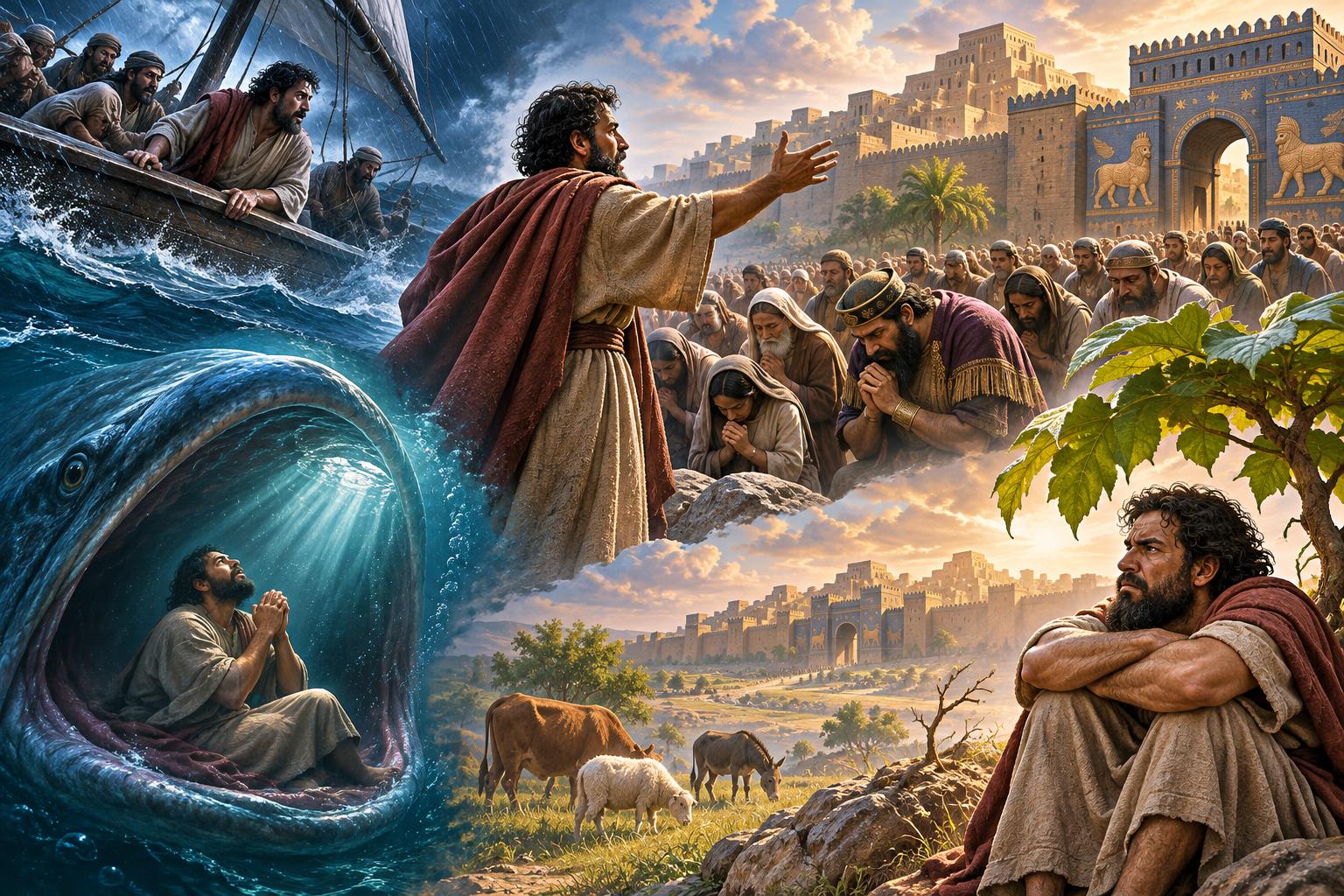
The Jonah Bible story is about more than a prophet swallowed by a great fish. Across Jonah 1–4, God sends Jonah to Nineveh, Jonah runs away, a storm and a fish interrupt his escape, and Nineveh responds to God’s warning with repentance. But the story’s final surprise is Jonah’s anger at God’s mercy. God’s unanswered question asks Jonah—and readers—whether compassion should extend even to people they would rather see judged.
Key takeaways
- The great fish is part of Jonah’s rescue, not the conclusion of the story. Jonah’s mission and his struggle with God’s compassion continue in chapters 3–4.
- Nineveh responds to God’s warning through fasting, humility, and turning from evil and violence; God sees their response and does not bring the announced disaster.
- Jonah says he fled because he knew God was gracious and compassionate. His resistance involves more than fear or simple disobedience.
- God shows concern for sailors, Jonah, Nineveh’s people, and even its animals, widening the reader’s understanding of mercy.
- The book ends without recording Jonah’s answer, leaving readers to consider whether they share God’s concern for people beyond their own community.
- In Matthew 12:38–41, Jesus connects Jonah’s experience with his own coming death and resurrection and highlights Nineveh’s response to preaching.
The setting: Why did God send Jonah to Nineveh?
The book opens with God telling Jonah son of Amittai to go to Nineveh and speak against its wickedness (Jonah 1:1–2). Jonah is also named as a prophet in 2 Kings 14:25.
Nineveh was an important Assyrian city. Assyria’s reputation for warfare and domination helps readers understand why an Israelite prophet might find this assignment difficult. However, the book does not initially tell us Jonah’s motive for fleeing. Jonah explains that himself in chapter 4.
Instead of heading toward Nineveh, Jonah travels to Joppa and boards a ship bound for Tarshish. The exact location of Tarshish is debated, but the narrative’s point is clear: Jonah is attempting to escape the mission God has given him (Jonah 1:3).
This establishes the story’s central tension. God is concerned about a wicked city, while God’s prophet resists becoming the messenger through whom that city might receive a warning.
Jonah 1 explained: The storm, the sailors, and the fleeing prophet
God sends a powerful storm, and the ship is in danger of breaking apart. The sailors cry out to their gods and throw cargo overboard, while Jonah sleeps below deck. The captain wakes him and urges him to call on his God (Jonah 1:4–6).
After the sailors cast lots, Jonah is identified as the person connected with the crisis. He tells them he worships the Lord, who made the sea and dry land, and admits that he is fleeing from the Lord. The contrast is striking: Jonah knows who God is, yet acts as though he can escape God’s presence.
Jonah tells the sailors to throw him into the sea. They initially resist and row hard toward land. Only when their efforts fail do they pray to the Lord and do what Jonah has said. The sea becomes calm, and the sailors respond with reverent fear, sacrifice, and vows (Jonah 1:7–16).
The chapter challenges easy assumptions about who will act faithfully. The foreign sailors show concern for Jonah’s life and respond to God, while the prophet runs away. Then God appoints a great fish to swallow Jonah, and Jonah remains inside it for three days and three nights (Jonah 1:17).
Jonah 2 explained: The great fish and Jonah’s prayer
From inside the fish, Jonah prays. His prayer looks back on sinking into the sea and describes his distress through vivid images of deep water, weeds, and the threat of death. He thanks God for hearing him and bringing his life up from the pit (Jonah 2:1–9).
The fish is frightening, but it also functions as God’s means of preserving Jonah’s life. The story does not identify its species. Many retellings call it a whale, but Jonah 1:17 describes a great or large fish, depending on the translation.
Jonah’s prayer expresses gratitude, dependence, and a commitment to fulfill his vows. It does not explicitly include an apology for fleeing or a declaration of compassion for Nineveh. That matters because the remaining chapters show that receiving mercy has not yet resolved Jonah’s resistance to mercy for others.
At God’s command, the fish vomits Jonah onto dry land (Jonah 2:10). This is a dramatic rescue, but the book is only halfway finished.
Jonah 3 explained: Nineveh hears the warning and repents
God commissions Jonah a second time, and this time Jonah goes to Nineveh. He announces that the city will be overthrown in forty days (Jonah 3:1–4).
The people believe God. They proclaim a fast and put on sackcloth, an outward sign of mourning and humility. When the message reaches the king, he leaves his throne, removes his robe, covers himself with sackcloth, and sits in ashes. A royal decree calls for fasting, urgent prayer, and a turning away from evil and violence. Even the animals are included in the citywide signs of distress (Jonah 3:5–8).
The king does not claim that these actions can force God to spare the city. Instead, he expresses hope that God may relent (Jonah 3:9).
God sees what the people do—especially their turning from evil—and does not bring the announced disaster (Jonah 3:10). The emphasis is not merely on religious gestures. Nineveh’s response includes a change in conduct.
Christian traditions explain the relationship between divine sovereignty, human response, and God’s relenting in different ways. The narrative’s central point is clear: the warning leads to repentance, and God responds with mercy. This describes Nineveh’s response at this moment, not a claim that the city remained faithful forever.
Jonah 4 explained: Why was Jonah angry at God?
Nineveh’s rescue deeply displeases Jonah. He tells God that this is why he originally fled: he knew God was gracious, compassionate, slow to anger, abundant in steadfast love, and willing to relent from disaster (Jonah 4:1–2). His description echoes God’s revelation of his character in Exodus 34:6–7.
Jonah is not angry because God has failed to be merciful. He is angry because God has shown mercy to Nineveh. His own explanation reveals the deeper problem behind his earlier flight.
Overwhelmed, Jonah says he would rather die than live. God answers with a question about whether his anger is right. Jonah then goes outside the city and sits under a shelter to see what will happen (Jonah 4:3–5).
God appoints a plant to provide shade, and Jonah is very glad about it. The next day, God appoints a worm that damages the plant, and it withers. A scorching east wind and the sun leave Jonah faint and angry again (Jonah 4:6–9).
The plant becomes an object lesson. Jonah cares intensely about something that brought him comfort, even though he did not grow it. God asks him to consider the far greater significance of an entire city.
Why the book ends with God’s unanswered question
God contrasts Jonah’s concern for the plant with divine concern for Nineveh: a great city containing more than 120,000 people who do not know their right hand from their left, as well as many animals (Jonah 4:10–11).
The description of people who cannot distinguish right from left has been understood in different ways. Some readers take it to refer to young children; others understand it as a picture of the population’s moral or spiritual lack of understanding. The text does not explicitly identify the group as children, so that interpretation should not be presented as certain.
God’s final question asks, in effect, whether he should not have compassion on Nineveh. The book records no reply from Jonah. It does not tell us whether he changes his mind, returns home, or rejoices in the city’s rescue.
That unresolved ending turns the question toward the reader. Can we celebrate receiving mercy while resenting mercy shown to someone else? Do we see people only through their wrongdoing or group identity, or also as lives that matter to God?
The story does not suggest that Nineveh’s violence was unimportant. God confronts it directly, and the people are called to turn from it. Mercy is not indifference to evil; here, God’s warning opens the way for repentance rather than destruction.
Jonah and Jesus: The sign of Jonah in Matthew 12:38–41
When some scribes and Pharisees ask Jesus for a sign, he points to the sign of Jonah. He connects Jonah’s three days and three nights in the great fish with the Son of Man’s coming time in the heart of the earth (Matthew 12:38–40). Christians understand this as pointing to Jesus’ death, burial, and resurrection.
Jesus also says that Nineveh’s people repented at Jonah’s preaching and that someone greater than Jonah is present (Matthew 12:41). The connection therefore involves both deliverance from death and the importance of responding to God’s message.
Jonah and Jesus should not be treated as identical in every respect. Jonah is a resistant messenger whose anger exposes his limited compassion. Christians confess Jesus as the faithful Son who reveals God’s mercy through his life, death, and resurrection.
For a beginner’s study, keep both connections in view: Jesus speaks about what will happen to him, and he challenges his hearers to respond rather than demand further signs.
Family-friendly retelling notes for Jonah 1–4
Tell all four movements of the story: Jonah runs, God rescues him, Nineveh responds, and God questions Jonah’s anger. Ending with the fish misses the book’s most searching lesson.
For younger children, explain repentance as turning away from wrong and toward God, including changing how we treat others. Describe Nineveh as a city where people were doing serious wrong, including hurting others, rather than portraying every resident as a frightening villain.
Retell the storm and fish scenes without adding graphic details or invented descriptions of the fish’s stomach. Say that the Bible calls it a great fish and focuses on God preserving Jonah and hearing his prayer.
Jonah twice says he would rather die. With young children, summarize that he became deeply upset and wanted to give up; with older children, read the wording sensitively and allow questions. Do not make his distress a joke or teach that painful emotions prevent someone from speaking honestly to God.
Finish with the plant and God’s final question. Ask, “Why did Jonah care so much about his shade? Why did God care about the people and animals?” Help children see that obedience matters, but so do compassion, humility, and welcoming mercy for others.
Share Scriptures reflection questions: Moving from rescue to compassion
Use these questions for personal reflection, a family conversation, or a small-group study. Read Jonah 1–4 before discussing them.
- Where do you notice God’s care for the sailors, Jonah, Nineveh, and the animals? Which example surprises you most?
- What does Jonah’s prayer reveal about his dependence on God? What does chapter 4 reveal that still needs to change?
- How does Nineveh show repentance through both words and actions? What might genuine turning from wrongdoing look like in your own life?
- Have you ever wanted patience for yourself but immediate consequences for someone else? What does Jonah’s experience expose about that tension?
- How can you desire someone’s repentance and well-being while still maintaining wise boundaries and seeking justice for harm?
- If you answered God’s final question, what would you say? What practical act of compassion could follow your answer?
A short closing prayer: “Gracious God, thank you for your patience with us. Help us turn from wrongdoing, receive your mercy humbly, and desire the good of people we find difficult to love. Amen.”
FAQs
Was Jonah swallowed by a whale or a great fish?
Jonah 1:17 describes a great or large fish, depending on the Bible translation, without naming a species. “Jonah and the whale” is a familiar retelling title, but “Jonah and the great fish” follows the wording of the book more closely. The narrative emphasizes God’s provision and Jonah’s rescue rather than the animal’s classification.
Why was Jonah angry when Nineveh repented?
Jonah 4:1–2 says Jonah was displeased that God spared Nineveh. He explains that he had fled because he knew God was gracious and compassionate and might relent from disaster. His anger exposes his resistance to mercy for Nineveh, even after he has received mercy himself.
What is the main lesson of the book of Jonah?
Obedience is one theme, but the whole book also explores repentance, God’s compassion, and resentment toward mercy shown to others. Nineveh turns from evil, while Jonah struggles to welcome God’s decision to spare it. The unanswered question in Jonah 4:11 invites readers to examine whether their concern for others reflects God’s compassion.
Go deeper in study
Explore Share Scriptures resources for Bible study, reflection, and small-group discussion. Use Jonah’s story to begin a conversation about repentance, mercy, and compassion for others.

Leave a Reply