
Listen to this article
What Is the Sermon on the Mount? A Plain-Language Guide to Matthew 5–7
The Sermon on the Mount is one of Jesus’ most important collections of teaching, found in Matthew 5–7. In it, Jesus describes the character, priorities, and daily practices of people who live under God’s kingdom. He teaches about humility, mercy, prayer, forgiveness, integrity, generosity, anxiety, judging others, and building life on a wise foundation. This guide offers the Sermon on the Mount explained in plain language for Christians, families, and Bible study groups who want to understand what Jesus taught and how Matthew 5–7 shapes faithful discipleship today.
Key takeaways
- The Sermon on the Mount is found in Matthew 5–7 and presents Jesus’ vision for life in the kingdom of heaven.
- The Beatitudes describe the surprising blessedness of the poor in spirit, the merciful, the pure in heart, peacemakers, and those persecuted for righteousness.
- Jesus calls His followers to visible faithfulness as “salt of the earth” and “light of the world” (Matthew 5:13–16).
- Matthew 6 teaches disciples to practice prayer, generosity, fasting, forgiveness, and trust in God without seeking human praise.
- Jesus warns against hypocritical judgment while still calling His followers to discernment, humility, and obedience.
- The sermon ends with a practical choice: build life on Jesus’ words like a wise person building on rock, or ignore them like a foolish person building on sand.
Sermon on the Mount explained: the setting and purpose
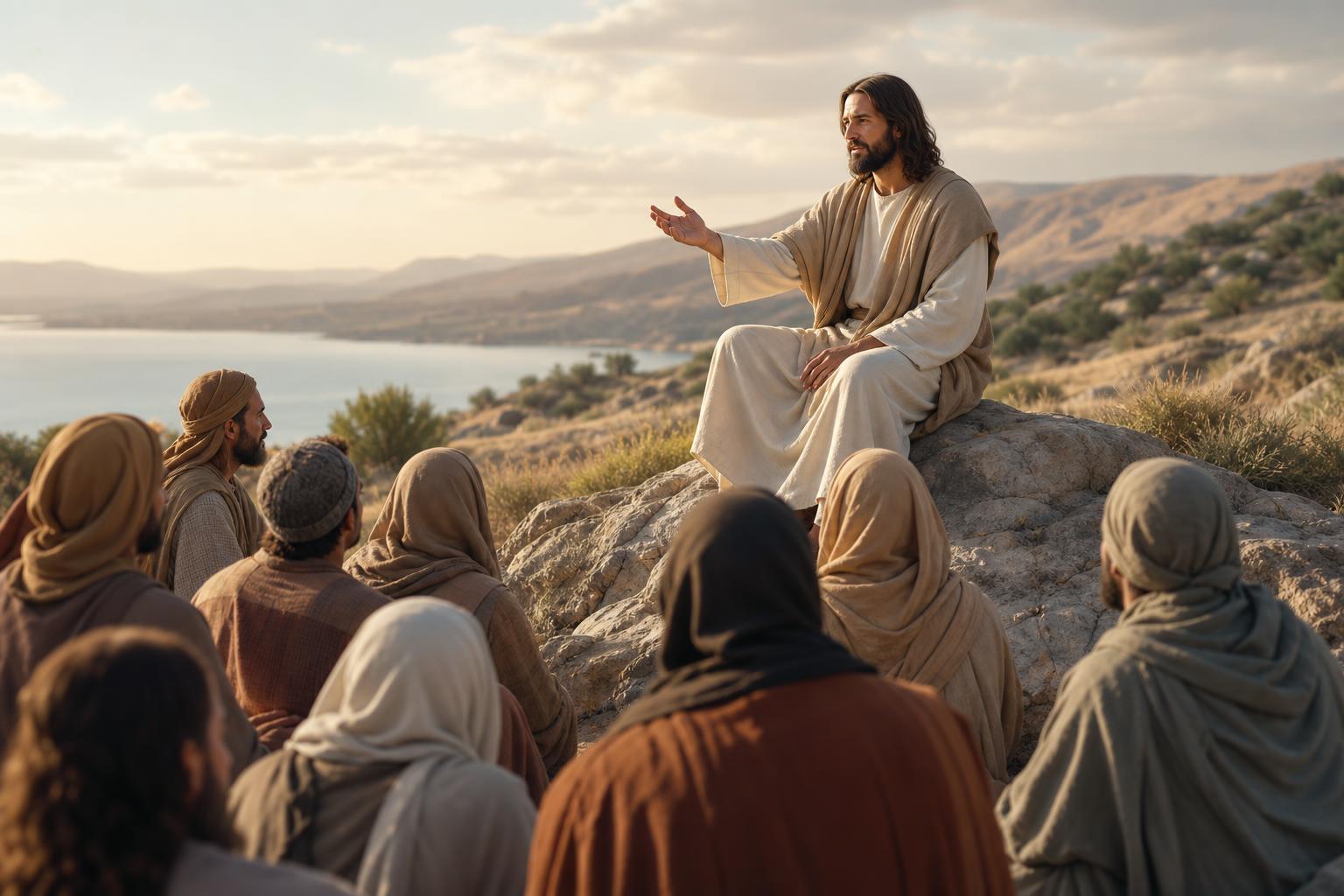
The Sermon on the Mount appears in Matthew 5–7. Jesus goes up on a mountain, sits down as a teacher, and speaks to His disciples while crowds also listen (Matthew 5:1–2). The mountain setting reminds many readers of Moses receiving the law on Mount Sinai, but Matthew presents Jesus as more than a lawgiver: He teaches with unique authority and reveals the heart of God’s kingdom. A simple Matthew 5–7 summary is this: Jesus describes what life looks like when people belong to the kingdom of heaven. The sermon is not merely a list of religious rules. It addresses the inner life, public witness, relationships, prayer, possessions, worry, judgment, and obedience. Jesus is not interested in outward performance without transformed hearts. He calls His followers to a righteousness that goes deeper than appearances (Matthew 5:20). Christians differ in how they describe the sermon’s relationship to the Old Testament law, grace, and the kingdom of God. Some traditions emphasize it as a rule of life for disciples. Others stress that it exposes human sin and drives people to grace. Many hold both together: the sermon reveals our need for God’s mercy and also teaches the Spirit-formed life of those who follow Jesus.
The Beatitudes meaning: blessing in God’s upside-down kingdom
The sermon begins with the Beatitudes (Matthew 5:3–12). The word “beatitude” comes from a term meaning blessed, favored, or deeply fortunate before God. Jesus announces blessing over people the world often overlooks: the poor in spirit, those who mourn, the meek, those hungry for righteousness, the merciful, the pure in heart, peacemakers, and those persecuted for righteousness. The Beatitudes do not praise misery for its own sake. They show that God’s kingdom belongs to people who know their need, depend on God, and reflect His character. “Poor in spirit” points to spiritual humility, not self-sufficiency. “Those who mourn” can include grief over suffering, sin, and the brokenness of the world. “The meek” are not weak; they are humble and surrendered to God rather than controlled by pride or revenge. For Bible study groups, the Beatitudes are a strong place to begin personal reflection. They ask: What kind of person is being formed in me? Do I hunger for righteousness? Do I practice mercy? Do I make peace? The Beatitudes meaning is not that Christians earn blessing by checking off virtues. Rather, Jesus names the kind of life that belongs to God’s reign and promises that God sees, comforts, fills, and vindicates His people.
Salt and light: visible discipleship in ordinary life
After the Beatitudes, Jesus tells His followers, “You are the salt of the earth” and “You are the light of the world” (Matthew 5:13–16). Salt preserves, seasons, and makes a difference by being distinct. Light reveals, guides, and cannot remain hidden. Jesus’ disciples are not called to withdraw from the world or blend into it without distinction. They are called to live in a way that points others to the Father. This part of the Sermon on the Mount connects Christian identity with public witness. Good works matter, but not as a way to glorify the self. Jesus says, “Let your light shine before others, so that they may see your good works and give glory to your Father in heaven” (Matthew 5:16). Christian living in Matthew 5 is therefore both humble and visible. In practice, being salt and light may include honesty at work, compassion toward the vulnerable, peacemaking in families, generosity with resources, and courage to do what is right even when it costs something. The emphasis is not performance for applause, but faithful presence that reflects God’s goodness.
Jesus and the law: righteousness from the heart
In Matthew 5:17–48, Jesus says He has not come to abolish the Law or the Prophets but to fulfill them. He then gives a series of teachings often introduced by the pattern, “You have heard that it was said… but I say to you.” These include anger and reconciliation, lust and purity, divorce, oaths, retaliation, and love for enemies. Jesus moves beneath outward behavior to the heart. Murder is not the only problem; anger, contempt, and unreconciled relationships also matter (Matthew 5:21–26). Adultery is not the only problem; lustful objectification also violates God’s intention for purity and love (Matthew 5:27–30). Truthfulness should be so consistent that elaborate oaths are unnecessary (Matthew 5:33–37). Love must reach beyond friends and neighbors to enemies (Matthew 5:43–48). Different Christian traditions explain “fulfill the law” in different ways. Some emphasize continuity with Old Testament moral teaching. Others highlight how Christ completes the law and establishes the new covenant. A balanced beginner-level reading should avoid flattening these differences: Matthew presents Jesus as the authoritative interpreter and fulfillment of Scripture, calling His disciples to a righteousness shaped by love, integrity, mercy, and wholeness.
Prayer, forgiveness, and hidden faithfulness in Matthew 6
Matthew 6 shifts attention to religious practices: giving, prayer, and fasting. Jesus warns against doing holy things for public praise. The issue is not whether people ever see a Christian’s faith, since Matthew 5 says light should shine. The issue is motive. Disciples should practice devotion before God rather than perform spirituality for admiration. Jesus’ teaching on prayer and forgiveness is central here. In the Lord’s Prayer (Matthew 6:9–13), Jesus teaches His followers to pray simply and faithfully: honoring the Father, seeking His kingdom, asking for daily bread, receiving forgiveness, forgiving others, and depending on God in temptation. The prayer is both personal and communal: “Give us,” “forgive us,” and “deliver us.” Jesus also makes forgiveness a serious discipleship issue (Matthew 6:14–15). Christians across traditions may explain the relationship between forgiveness and salvation with different theological language, but all should take Jesus’ warning seriously. Those who have received mercy are called to become merciful people. Forgiveness does not always mean ignoring harm, avoiding justice, or immediately restoring trust. But it does mean releasing revenge to God and refusing to let bitterness rule the heart.
Treasure, anxiety, and trusting the Father
In Matthew 6:19–34, Jesus teaches about treasure, money, worry, and trust. He warns against storing up treasures on earth as the center of life because earthly treasures can be lost, stolen, or destroyed. Instead, disciples are to store up treasures in heaven, living for what endures before God. Jesus also addresses anxiety: “Do not worry about your life” (Matthew 6:25). This does not mean Christians should ignore responsibilities, financial planning, medical care, or the realities of hardship. Jesus is not shaming people who experience anxiety or deep distress. He is calling disciples to remember the Father’s care. Birds are fed, lilies are clothed, and human beings are worth more than these (Matthew 6:26–30). The key command is, “Seek first the kingdom of God and his righteousness” (Matthew 6:33). Christian living in Matthew 5–7 is not built on denial, greed, or fear. It is built on trust. A group discussion might ask: What worries most easily take first place in our hearts? What would it look like to seek God’s kingdom first in spending, schedules, family life, and church ministry?
Judging others, asking God, and the narrow way
Matthew 7 begins with one of Jesus’ most quoted commands: “Do not judge, so that you may not be judged” (Matthew 7:1). Jesus is not forbidding all moral discernment. Later in the same chapter, He warns about false prophets and says people can be recognized by their fruit (Matthew 7:15–20). The warning is against hypocritical, self-righteous judgment that sees another person’s speck while ignoring one’s own log (Matthew 7:3–5). Jesus then encourages humble prayer: ask, seek, and knock (Matthew 7:7–11). The Father is generous and good. This section does not reduce prayer to getting everything we want. Rather, it invites trust in the Father’s goodness and persistence in seeking Him. Matthew 7 also includes the Golden Rule: “In everything, do to others as you would have them do to you” (Matthew 7:12). Jesus then speaks of the narrow gate, true and false prophets, true and false disciples, and wise and foolish builders. The sermon’s final movement presses listeners beyond admiration into response. Hearing Jesus is not enough; discipleship involves trusting and obeying Him.
Wise foundations: how the sermon ends
The Sermon on the Mount ends with a vivid image: two builders, two houses, one storm (Matthew 7:24–27). The wise builder hears Jesus’ words and acts on them. His house is built on rock and stands when rain, floods, and winds come. The foolish builder hears the same words but does not act on them. His house is built on sand and falls. This ending clarifies the purpose of the entire sermon. Jesus is not offering inspirational ideas for occasional reflection. He is calling for a whole-life response. The Beatitudes, enemy-love, prayer, forgiveness, trust, humility, and obedience are not separate topics; they form a kingdom way of life under the authority of Jesus. For a Sermon on the Mount Bible study, a helpful closing question is: What part of Jesus’ teaching do I most need to put into practice this week? The goal is not to master Matthew 5–7 as information only, but to become people whose lives are built on the words of Christ.
FAQs
What is the main message of the Sermon on the Mount?
The main message is that Jesus calls His disciples to live under God’s kingdom with humility, mercy, integrity, prayer, forgiveness, trust, and obedience. It reveals both the depth of God’s righteousness and the kind of transformed life Jesus forms in His followers.
Is the Sermon on the Mount a list of rules Christians must follow to be saved?
Christian traditions explain this differently, but historic Christianity generally avoids treating the sermon as a way to earn salvation. The sermon exposes the heart, shows the need for grace, and teaches the life of disciples who trust and follow Jesus.
How can a small group study Matthew 5–7 well?
Read the sermon in sections, observe what Jesus says, discuss the heart issues underneath each command, and choose specific applications. Good discussion topics include the Beatitudes, anger and reconciliation, prayer, forgiveness, anxiety, judging others, and building life on Jesus’ words.
Go deeper in study
Use FaithPath resources for Bible study, reflection, and small-group discussion.

Leave a Reply