
Listen to this article
Who Was Mary Magdalene in the Bible? Her Story, Misconceptions, and Witness to the Resurrection
Mary Magdalene was a devoted follower of Jesus who appears in all four Gospels and is especially remembered as one of the first witnesses to the resurrection. The Bible identifies her as a woman from whom Jesus had cast out seven demons, a supporter of His ministry, a witness at the crucifixion and burial, and the first person named in John 20 to encounter the risen Christ. Many popular claims about Mary Magdalene come from later tradition, art, novels, or speculation rather than the biblical text. A careful reading helps us honor what Scripture actually says while recognizing how later Christian history has interpreted her life.
Key takeaways
- Mary Magdalene was a faithful disciple of Jesus and is named among women who supported His ministry in Luke 8:1–3.
- The Bible says Jesus delivered Mary Magdalene from seven demons, but it does not identify her as a prostitute or as the sinful woman of Luke 7.
- Mary Magdalene witnessed Jesus’ crucifixion and burial, remaining present when many others had fled, according to passages such as Mark 15:40–41.
- John 20:1–18 presents Mary Magdalene as the first named witness to the risen Jesus and the first person sent to announce the resurrection to the disciples.
- Many misconceptions about Mary Magdalene come from later church tradition, artistic interpretation, or modern speculation rather than direct biblical evidence.
Mary Magdalene in the Gospels: What the Bible Actually Says
Mary Magdalene is introduced most clearly in Luke 8:1–3. As Jesus traveled through cities and villages proclaiming the kingdom of God, Luke names several women who accompanied Him and supported His ministry. Among them was “Mary, called Magdalene, from whom seven demons had gone out” (Luke 8:2). Her title likely means she came from Magdala, a town near the Sea of Galilee. This detail distinguishes her from other women named Mary in the New Testament, such as Mary the mother of Jesus, Mary of Bethany, and Mary the mother of James. The Gospels do not give a full biography of Mary Magdalene. They do not tell us about her family, marital status, age, or occupation. What they do emphasize is her transformation by Jesus and her faithful presence in His ministry. The phrase “seven demons” points to severe spiritual oppression from which Jesus delivered her. In biblical symbolism, seven can suggest fullness or completeness, though the text does not require us to know the exact nature of her affliction. The central point is that Jesus restored her, and she became a devoted follower.
Luke 8 Mary Magdalene Explained: A Disciple and Supporter of Jesus’ Ministry
Luke 8:1–3 is one of the most important Mary Magdalene Bible verses because it shows that women were active participants in Jesus’ ministry. Mary Magdalene, Joanna, Susanna, and “many others” are described as supporting Jesus and the Twelve “out of their means.” This does not mean Mary was one of the Twelve apostles, but it does show she belonged to the wider circle of Jesus’ disciples. For intermediate Bible readers, this passage is significant for several reasons. First, it highlights Jesus’ inclusion of women as learners, followers, and ministry supporters in a cultural context where public religious instruction was often male-dominated. Second, it shows that discipleship involved practical support as well as listening and following. Third, Mary’s deliverance did not reduce her to her past suffering; instead, Scripture presents her as a restored person who responded with faithful service. Luke’s account does not romanticize Mary Magdalene or use her as a symbol of scandal. It presents her as someone transformed by the mercy of Christ and incorporated into the mission of the kingdom of God.
Mary Magdalene at the Cross and Burial
Mary Magdalene appears again at the end of Jesus’ earthly ministry. Mark 15:40–41 says that Mary Magdalene, Mary the mother of James the younger and Joses, and Salome watched the crucifixion from a distance. Mark adds that these women had followed Jesus and ministered to Him when He was in Galilee, and that many other women had come up with Him to Jerusalem. This scene matters because Mary Magdalene remained present at the darkest moment of the Gospel story. While the male disciples are largely absent from Mark’s crucifixion scene, these women bear witness to Jesus’ suffering and death. They did not have power to stop the execution, but they remained faithful witnesses. Mary Magdalene is also associated with Jesus’ burial. In Mark 15:47, Mary Magdalene and Mary the mother of Joses saw where Jesus was laid. This detail is important for the resurrection narratives because it establishes that the women knew the location of the tomb. Their later discovery of the empty tomb is not presented as confusion over the burial place, but as part of the Gospel testimony that Jesus had truly died, was buried, and was raised.
John 20 Mary Magdalene: Witness to the Resurrection
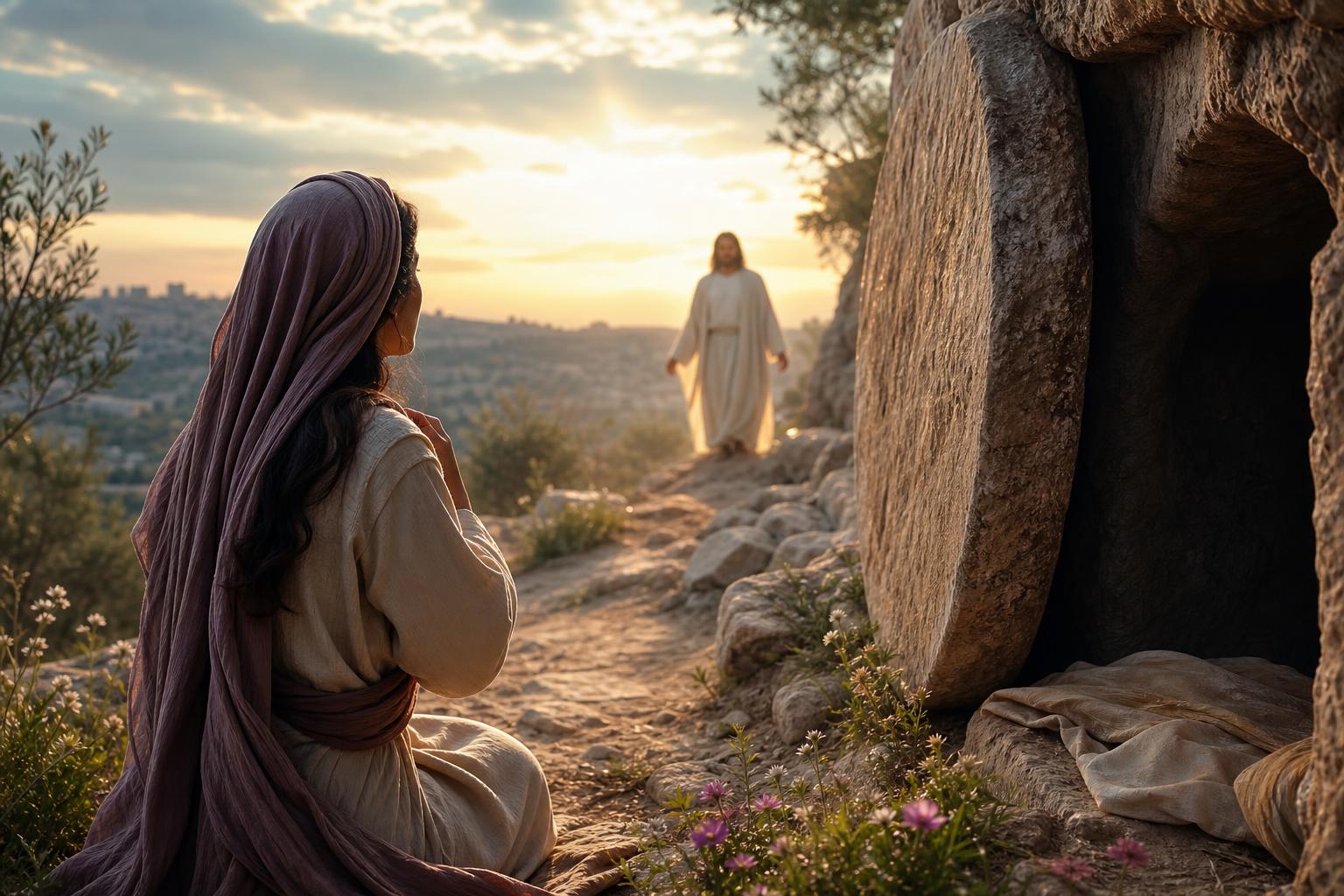
John 20:1–18 gives the most personal account of Mary Magdalene’s encounter with the risen Jesus. Mary comes to the tomb early, while it is still dark, and finds the stone removed. She runs to tell Peter and the beloved disciple, saying, “They have taken the Lord out of the tomb, and we do not know where they have laid him” (John 20:2). After the two disciples inspect the tomb and leave, Mary remains weeping outside. Mary then sees two angels and, shortly afterward, Jesus Himself, though she initially mistakes Him for the gardener. When Jesus calls her by name, “Mary,” she recognizes Him and responds, “Rabboni!” meaning Teacher (John 20:16). Jesus then sends her with a message: “Go to my brothers and say to them…” (John 20:17). Mary announces to the disciples, “I have seen the Lord” (John 20:18). This makes Mary Magdalene a central resurrection witness. In John’s Gospel, she is the first named person to encounter the risen Christ and the first to proclaim the resurrection message to the disciples. Some Christian traditions have called her “apostle to the apostles” in recognition of this commissioned announcement. That title is a later interpretive phrase, not a direct biblical title, but it reflects the importance of her role in John 20.
Common Misconceptions About Mary Magdalene
Several misconceptions about Mary Magdalene are common in sermons, films, artwork, and popular culture. The most widespread is the idea that Mary Magdalene was a prostitute. The Bible never says this. This association developed in parts of Western church tradition when Mary Magdalene was connected with the unnamed “sinful woman” in Luke 7:36–50 and sometimes with Mary of Bethany in John 12. Some traditions made these women one figure, while many modern biblical scholars and many Christian traditions distinguish them because the texts do not explicitly identify them as the same person. Another misconception is that Mary Magdalene was Jesus’ wife or romantic partner. The New Testament does not teach this. Such claims usually come from later writings, modern fiction, or speculative reconstructions rather than the canonical Gospels. Christians may discuss later texts historically, but they should not be confused with the biblical witness. A third misconception is that Mary Magdalene’s importance depends on scandal or secrecy. In Scripture, her significance is not based on hidden status but on visible faithfulness: she was delivered by Jesus, supported His ministry, remained near the cross, observed His burial, and testified to His resurrection.
Why Mary Magdalene’s Story Matters for Christians Today
Mary Magdalene’s story invites Christians to see discipleship as grateful, courageous, and witness-bearing. She was not defined by the demonic oppression from which Jesus delivered her. She became a follower whose life pointed to the restoring power of Christ. Her presence at the crucifixion reminds believers that faithfulness sometimes means remaining near Jesus in grief, confusion, and apparent defeat. Her resurrection witness also matters for Christian faith formation. The Gospel writers do not hide the fact that women were the first witnesses to the empty tomb and, in John’s account, that Mary Magdalene was the first to see the risen Lord. In a setting where women’s testimony was often undervalued, the Gospels preserve this testimony as central to the resurrection story. For Bible study groups, Mary Magdalene’s profile offers a helpful example of how to read Scripture carefully: affirm what the text says, avoid repeating unsupported claims, and recognize how Jesus dignifies and commissions those who follow Him.
FAQs
Who was Mary Magdalene in the Bible?
Mary Magdalene was a follower of Jesus from whom He cast out seven demons. She supported His ministry, witnessed His crucifixion and burial, and, according to John 20:1–18, was the first named person to encounter the risen Christ and announce His resurrection to the disciples.
Was Mary Magdalene the sinful woman in Luke 7?
The Bible does not identify Mary Magdalene as the sinful woman in Luke 7:36–50. Some later Western church traditions connected them, but the Gospel text does not explicitly say they are the same person. Many interpreters distinguish Mary Magdalene from both the unnamed sinful woman and Mary of Bethany.
Why is Mary Magdalene important to the resurrection story?
Mary Magdalene is important because all four Gospels include women as early witnesses to the empty tomb, and John 20 specifically presents Mary as the first named witness to the risen Jesus. Her testimony, “I have seen the Lord,” is a key moment in the Gospel proclamation of the resurrection.
Go deeper in study
Use FaithPath resources for Bible study, reflection, and small-group discussion.

Leave a Reply