
Listen to this article
Who Was Ruth in the Bible? Story, Character, and Lessons from the Book of Ruth
Ruth in the Bible was a Moabite woman whose faithfulness to her mother-in-law Naomi, trust in the God of Israel, and marriage to Boaz became part of God’s redemptive story. Her story is told in the Book of Ruth, a short but deeply meaningful Old Testament narrative set during the time of the judges. Ruth is remembered for covenant loyalty, humility, courage, and steadfast love in the middle of grief and uncertainty. She also becomes the great-grandmother of King David and is named in the genealogy of Jesus Christ in Matthew 1:5, showing how God’s providence works through ordinary acts of faithfulness.
Key takeaways
- Ruth was a Moabite widow who chose loyalty to Naomi and faith in the God of Israel rather than returning to her former life.
- The Book of Ruth highlights covenant loyalty, often connected with the Hebrew word hesed, meaning steadfast love, kindness, or faithful devotion.
- Boaz acts as a redeemer figure by protecting Ruth, honoring Naomi’s family line, and marrying Ruth according to Israel’s family customs.
- Ruth’s story shows God’s providence at work through grief, migration, harvest fields, community responsibility, and faithful human choices.
- Ruth became the great-grandmother of King David and is included in the genealogy of Jesus in Matthew 1:5.
Ruth Bible Story Summary
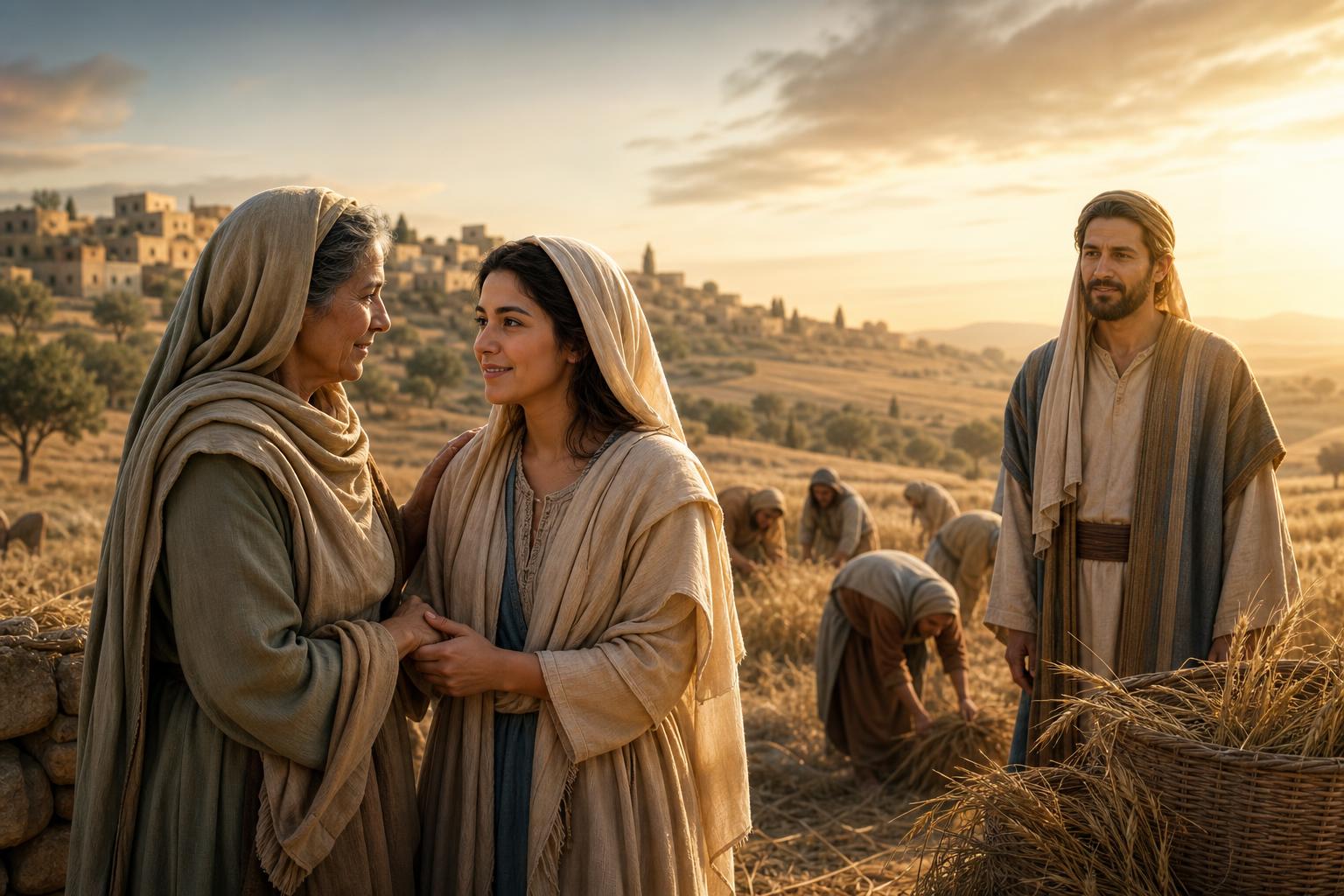
The Book of Ruth takes place during the days of the judges, a spiritually troubled period in Israel’s history. A famine leads Elimelech, Naomi, and their two sons to leave Bethlehem and settle in Moab. Naomi’s sons marry Moabite women, Ruth and Orpah. After Elimelech and both sons die, Naomi decides to return to Bethlehem because she has heard that the Lord has provided food for His people (Ruth 1:6). Orpah returns to her people, but Ruth clings to Naomi and speaks one of the most memorable declarations of loyalty in Scripture: “Your people shall be my people, and your God my God” (Ruth 1:16). In Bethlehem, Ruth gleans grain in the field of Boaz, a relative of Naomi’s late husband. Boaz notices Ruth’s kindness to Naomi and protects her. Naomi later guides Ruth to appeal to Boaz as a family redeemer. Boaz agrees, after first resolving the legal matter with a nearer relative. Boaz marries Ruth, and they have a son named Obed, who becomes the grandfather of David (Ruth 4:17).
Ruth and Naomi Explained
Ruth and Naomi’s relationship is central to the story. Naomi returns to Bethlehem grieving and bitter, saying, “Call me Mara,” because she feels the Lord has dealt bitterly with her (Ruth 1:20). Ruth, however, stays with Naomi not because it is easy or beneficial, but because she has committed herself to Naomi’s people and Naomi’s God. This loyalty is costly: Ruth leaves her homeland, family network, and familiar customs. Her commitment shows love expressed through action. For Bible study groups, Ruth and Naomi’s story can open conversations about grief, caregiving, intergenerational faith, and God’s presence when life feels empty. Naomi’s story also reminds readers that faith does not always sound triumphant; sometimes it speaks honestly from pain while God is still working in hidden ways.
Boaz and Ruth Meaning
Boaz is introduced as a worthy man from the clan of Elimelech (Ruth 2:1). He shows generosity by allowing Ruth to glean safely in his fields and by instructing his workers not to mistreat her. In the context of ancient Israel, gleaning was a provision in the law that allowed the poor, widows, and foreigners to gather leftover grain (see Leviticus 19:9-10; Deuteronomy 24:19). Boaz goes beyond minimum duty by offering Ruth protection and abundance. Later, Boaz becomes a family redeemer, sometimes called a kinsman-redeemer. This role involved preserving family inheritance and caring for vulnerable relatives. Christian readers often see Boaz’s actions as reflecting themes of redemption, kindness, and covenant responsibility. It is best to say that Boaz points toward God’s redemptive character without flattening the story into a simple allegory. The Book of Ruth is first a real narrative about faithful people, social responsibility, and God’s providence.
Ruth’s Character: Faithfulness, Courage, and Humility
Ruth’s character is one reason her story continues to encourage Christians. She is faithful when there is no guarantee of reward. She is courageous as a foreign widow entering Bethlehem with few resources. She is humble in her willingness to glean, a lowly and physically demanding form of provision. She is also active rather than passive. Ruth makes a vow, goes to the field, works diligently, listens to Naomi’s counsel, and approaches Boaz with wisdom and respect. Her story does not portray faith as mere feeling but as loyal obedience in daily life. Ruth’s example is especially useful for devotionals and women’s Bible studies because it shows that spiritual strength can appear in quiet perseverance, sacrificial love, and ordinary faithfulness.
God’s Providence in the Book of Ruth
One of the most important lessons from the book of Ruth is that God’s providence often works through ordinary circumstances. The text says Ruth “happened to come” to the part of the field belonging to Boaz (Ruth 2:3), yet the larger story shows that this apparent chance becomes part of God’s care for Naomi, Ruth, and Israel’s future. God’s name is not attached to every event, but His faithfulness is visible across the whole narrative. The famine, loss, return to Bethlehem, harvest season, Boaz’s kindness, and the birth of Obed all come together in a way the characters could not have planned. This makes Ruth a powerful book for readers facing uncertainty. It teaches that God may be working through small obediences, timely relationships, and quiet provisions.
Ruth in the Lineage of David and Jesus
Ruth’s significance extends beyond her personal story. Ruth and Boaz have a son named Obed, who becomes the father of Jesse and the grandfather of King David (Ruth 4:17-22). The New Testament also names Ruth in the genealogy of Jesus: “Boaz the father of Obed by Ruth” (Matthew 1:5). This is remarkable because Ruth was a Moabite, a foreigner brought into the covenant community. Her inclusion in Jesus’ genealogy highlights God’s grace and the surprising ways He advances His promises. Christians should be careful not to reduce Ruth’s value only to motherhood or ancestry; her faithfulness matters in its own right. Still, her place in the messianic line shows that God weaves faithful lives into a much larger story of redemption.
Lessons from the Book of Ruth for Today
The Book of Ruth offers practical lessons for individuals, families, and church groups. It teaches loyalty in relationships, compassion for the vulnerable, integrity in romance and marriage, and trust in God’s provision. It also challenges communities to care for widows, immigrants, and the poor. Ruth’s story can help believers reflect on how faith is lived out in grief, work, family responsibility, and decision-making. For small groups, useful discussion questions include: Where do you see costly loyalty in Ruth’s life? How does Boaz use his power to protect rather than exploit? What does Naomi’s grief teach us about honest prayer? How might God be at work in ordinary circumstances today?
FAQs
Why is Ruth important in the Bible?
Ruth is important because her story displays faithful love, courageous trust, and God’s providence. She also becomes part of the family line of King David and is named in the genealogy of Jesus in Matthew 1:5.
What does Ruth teach us about faithfulness?
Ruth teaches that faithfulness is more than words. She remains with Naomi, leaves her homeland, works to provide food, and trusts the God of Israel. Her loyalty is sacrificial, practical, and rooted in commitment.
What does Boaz represent in Ruth’s story?
Boaz represents righteous character, generosity, and responsible care for the vulnerable. As a family redeemer, he protects Ruth and helps preserve Naomi’s family line. Many Christian readers also see his actions as reflecting broader biblical themes of redemption.
Go deeper in study
Use FaithPath resources for Bible study, reflection, and small-group discussion.

Leave a Reply