
Listen to this article
David and Goliath Bible Story: Meaning, Lessons, and Study Questions
The David and Goliath Bible story meaning is not simply that brave people can defeat big problems. In 1 Samuel 17, David trusts the living God when Israel’s army is afraid, and the Lord gives victory over the Philistine champion. This story teaches faith, courage, humility, and dependence on God’s power rather than outward strength. It is useful for children, families, personal devotion, and church study because it shows how God works through an unlikely servant for His purposes.
Key takeaways
- David and Goliath is found in 1 Samuel 17, during a conflict between Israel and the Philistines.
- The story’s main focus is trust in the living God, not merely human courage or positive thinking.
- David’s confidence comes from God’s past faithfulness and God’s covenant relationship with Israel.
- Goliath appears powerful, but the narrative shows that the Lord is greater than human strength, weapons, and intimidation.
- This faith and courage Bible story can be taught to kids, adults, and small groups with applications rooted in dependence on God.
Bible Story Summary: David and Goliath in 1 Samuel 17
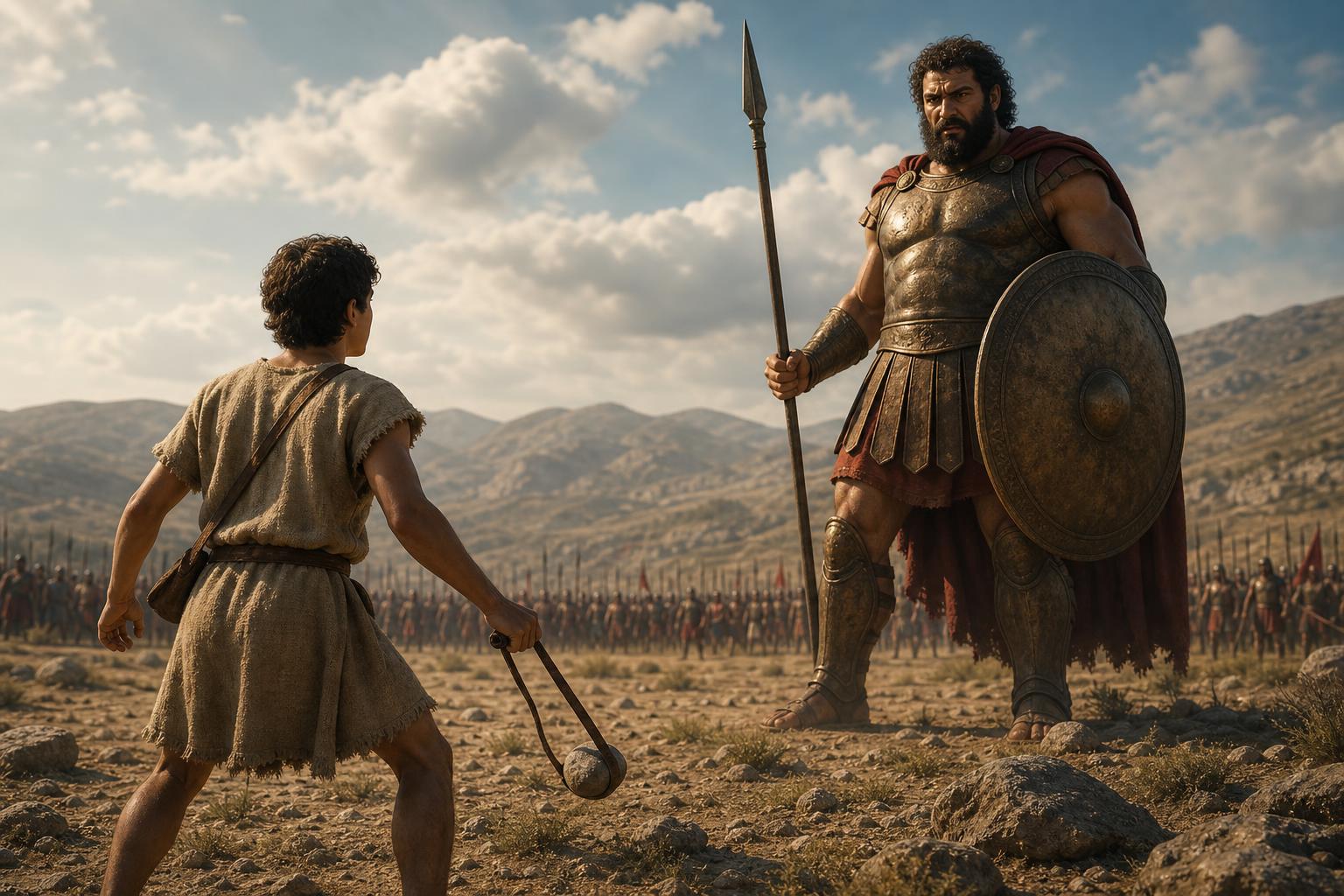
In 1 Samuel 17, Israel and the Philistines face each other in battle. The Philistines have a champion named Goliath, a giant warrior from Gath, who challenges Israel to send one man to fight him. For forty days, Goliath mocks Israel and terrifies Saul’s army. David, a young shepherd and the son of Jesse, comes to the battlefield to bring food to his brothers. When he hears Goliath defying the armies of the living God, David is troubled. He remembers how God helped him protect his sheep from a lion and a bear, and he believes God can deliver him again. King Saul offers David his armor, but David is not used to it. Instead, David goes with his shepherd’s staff, sling, and five smooth stones. Goliath insults him, but David declares that the battle belongs to the Lord. David strikes Goliath with a stone, defeats him, and Israel sees that God saves not by sword or spear, but by His power.
Biblical Context: Israel, the Philistines, and Saul’s Fear
The David and Goliath Bible story takes place during the early monarchy of Israel. Saul is king, but his leadership has already been marked by disobedience and fear. In contrast, David has been anointed by Samuel in 1 Samuel 16, though he is not yet publicly ruling as king. The Philistines were a powerful neighboring people who often fought against Israel. Their military strength, iron weapons, and fortified cities made them a serious threat. Goliath represents more than a personal obstacle for David; he stands as a public enemy who defies Israel and dishonors the Lord. This context helps readers avoid turning the story into a simple self-help lesson. David is not chasing personal fame or proving he is better than others. He is responding in faith because God’s name and God’s people are being mocked.
David and Goliath Bible Story Meaning
The central meaning of David and Goliath is that God is trustworthy and able to deliver His people according to His purposes. David’s courage is real, but it is not confidence in himself. His words in 1 Samuel 17:45–47 make the point clear: David comes in the name of the Lord, and he says that the battle is the Lord’s. Goliath relies on size, armor, weapons, and intimidation. Saul’s army sees the same things and becomes afraid. David sees the situation through faith. He remembers God’s past deliverance and believes God is greater than the visible threat. For Christians, many teachers also see David as pointing forward to the kind of king God provides: a faithful representative who wins victory for his people. Different Christian traditions may emphasize this connection in different ways, but the story itself clearly contrasts fearful human leadership with God-dependent faith.
Lessons for Adults: Faith, Courage, and Dependence on God
A David and Goliath lesson for adults should go deeper than saying, “Face your giants.” The story does encourage courage, but biblical courage is rooted in God’s character, not in self-confidence alone. Adults can reflect on several lessons. First, fear often grows when we focus only on what we can see. Israel saw Goliath’s size; David remembered God’s power. Second, past faithfulness strengthens present faith. David’s experience with the lion and bear prepared him for the battlefield. Third, faithfulness may look foolish to others. David’s brothers questioned him, Saul doubted him, and Goliath mocked him. The application is not that every challenge will end exactly as we hope, but that God is worthy of trust in every challenge. Believers can pray, obey, seek wisdom, and act courageously while leaving the outcome in God’s hands.
David and Goliath for Kids and Families
When teaching David and Goliath for kids, keep the story vivid but centered on God. Children often remember the sling, the stones, and the giant, but the key lesson is that David trusted God when others were afraid. A simple explanation for children is: “David was small compared to Goliath, but God was stronger than Goliath. David trusted God, and God helped him.” Families can connect this to everyday fears, such as speaking truth, asking forgiveness, going to a new school, or doing what is right when others laugh. Avoid teaching children that they can defeat every problem if they are brave enough. Instead, teach them that God is near, God hears prayer, and God helps His people obey Him with courage.
1 Samuel 17 Study Guide and Discussion Questions
Use these David and Goliath discussion questions for personal study, family devotions, Sunday school, or small groups: 1. What details in 1 Samuel 17 show why Israel was afraid of Goliath? 2. How does David describe Goliath’s challenge differently from the soldiers? 3. What does David remember from his past that strengthens his faith? 4. Why does David refuse Saul’s armor? 5. What does 1 Samuel 17:45–47 teach about the real source of victory? 6. How can we avoid making this story only about personal success? 7. What fears or pressures tempt you to forget God’s faithfulness? 8. How can your family, class, or small group practice courage that depends on God? For a simple study plan, read 1 Samuel 17 in sections: verses 1–11 for the threat, verses 12–30 for David’s arrival, verses 31–40 for David before Saul, verses 41–54 for the battle, and verses 55–58 for David’s introduction to Saul.
FAQs
What is the main meaning of the David and Goliath Bible story?
The main meaning is that God is greater than human strength, fear, and intimidation. David’s victory shows trust in the living God, who delivers according to His purposes.
Is David and Goliath just a story about facing your giants?
That phrase can be a helpful starting point, but it can also oversimplify the passage. The story is not mainly about self-confidence; it is about faith in God, His honor, and His power to save.
How can I teach David and Goliath to kids?
Tell the story clearly from 1 Samuel 17, explain that David trusted God, and help children name situations where they need God’s help to do what is right. Keep the focus on God’s faithfulness rather than on David being naturally brave.
Go deeper in study
Use Share Scriptures resources for Bible study, reflection, and small-group discussion.

Leave a Reply